Reuse at Scale: How University of Michigan Dining Built a Campus-Wide Reusable To-Go System
May 14, 2026
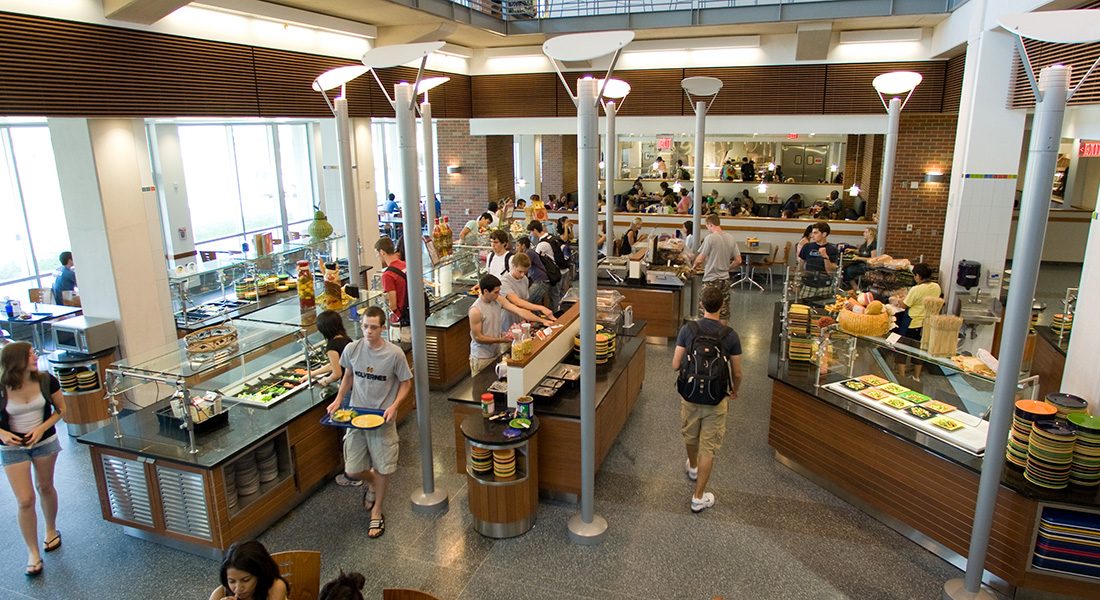
University of Michigan Dining (M|Dining) operates one of the largest campus dining systems in the country, serving tens of thousands of meals each week across multiple dining halls and retail locations in Ann Arbor. The program supports approximately 15,000 students on meal plans daily, along with faculty, staff, and retail customers. With an estimated 400 takeout meals per day (roughly 5% of total meals served), M|Dining faces significant operational and environmental implications tied to food packaging decisions.
The Problem: Single-use Foodware a Growing Concern on Campus
Like many large institutions, M|Dining faced growing concerns around single-use foodware waste, rising disposal costs, and student expectations for sustainability leadership. While compostable foodware was available through vendors, leadership recognized that compostables alone did not sufficiently address upstream waste reduction, contamination risks, or long-term cost control, particularly when infrastructure failures or supply chain disruptions occurred (such as during the COVID-19 pandemic).
A critical moment underscored the vulnerability of disposable-dependent systems: when a dishwasher outage temporarily halted reuse operations, M|Dining spent nearly $90,000 on disposable products in a single week. This incident reinforced both the financial and environmental risks of relying on single-use foodware at scale.
Additionally, leadership reported operational challenges common to institutional dining, including:
- Storage and drying space for foodware
- Container loss and replacement costs
- Customer (student, faculty, staff, retail consumers) compliance with returns
- Staff training and workflow integration
Rather than defaulting to compostables as a universal solution, M|Dining sought an approach that prioritized waste prevention first.
The Solution: A Reusable-First Model
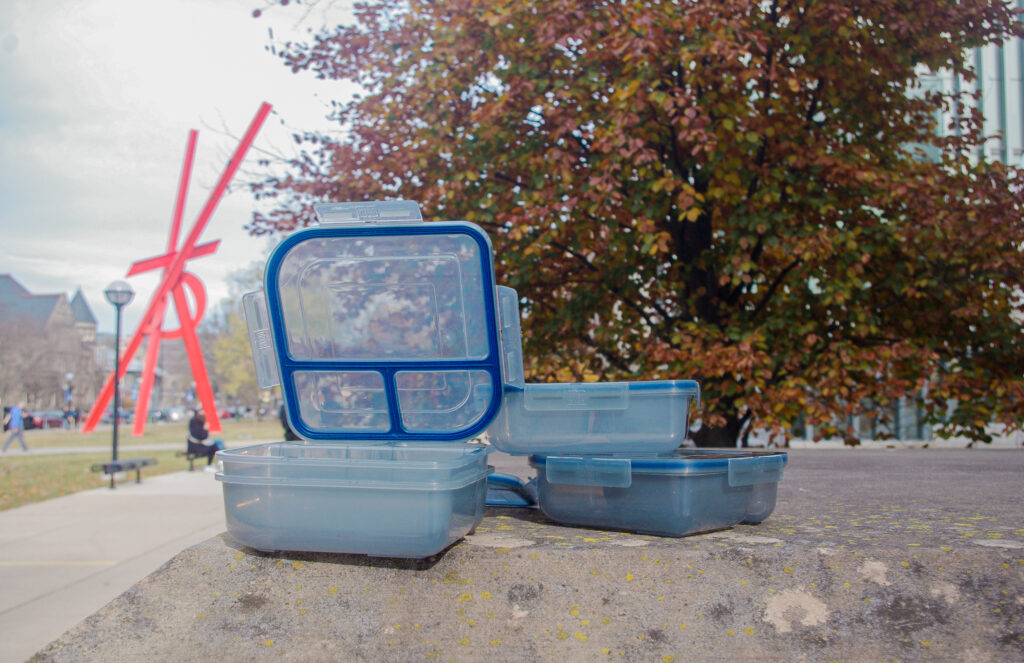
M|Dining implemented the MyGo reusable container program, a closed-loop, deposit-style system integrated directly into the student meal plan infrastructure.
How the Program Works
- Students receive one reusable MyGo container credit at the start of the semester, linked to their student ID.
- When selecting to-go meals, students check out a reusable container.
- After use, containers are rinsed and returned to dining locations to regain the credit for future use.
- Containers are washed using existing industrial dishwashing equipment and dried on racks designed to accommodate high volumes.
Compostable containers are used only as a backup option when reusable inventory is temporarily depleted, reinforcing reuse as the default rather than the exception.
Why M Dining Chose Reusables Over Compostables
Several factors influenced M|Dining’s decision to prioritize reusable containers:
- Waste Prevention: Reusables eliminate waste entirely rather than shifting it to composting systems that may be limited or inconsistent.
- Cost Control: While reusables require upfront investment, long-term costs are significantly lower than ongoing disposable purchasing, especially during disruptions.
- Operational Compatibility: Reusables work within existing dishwashing infrastructure, whereas compostables introduce contamination and sorting challenges.
- Student Experience: Durable containers perform better for hot foods and transport, improving usability and satisfaction.
- Values Alignment: Leadership viewed compostables as a secondary tool, best reserved for specific applications like soups, smoothies, and select retail items.
According to Senior Director Steve Giardini, compostable products are “useful but not ideal” and should not replace reuse when reuse is feasible.
Implementation History and Key Considerations
The MyGo reusable container program was rolled out in phases, beginning with dining halls where meal plan integration and container tracking could be most easily managed. These controlled environments allowed M Dining to test workflows, refine staff training, and normalize reuse as the default option for to-go meals. Retail locations follow a different trajectory, maintaining compostable packaging where reuse posed greater logistical challenges.
Over time, several operational considerations emerged as central to the program’s success. Container loss does occur, particularly in a campus environment with high student turnover, but leadership found it manageable when expectations were clearly communicated and systems were kept simple. Adequate drying and storage space proved essential: drying racks and back-of-house layout had to be intentionally planned to accommodate large volumes of reusable containers moving through daily wash cycles.
Customer education also played a large role. While most students adapted quickly to the rinse-and-return model, reminders (especially at the start of the semesters) helped reduce forgotten containers and reinforce reuse norms across campus. Frontline staff became key ambassadors of the program, guiding students through the process and ensuring consistency across dining locations.
Despite these challenges, M|Dining reports that the reusable system functions smoothly at scale and delivers substantial cost savings when fully operational. Importantly, reuse reduced the program’s exposure to supply chain disruptions and price volatility associated with disposable products.
Current Foodware Practices
Today, M|Dining operates with a reuse-first framework across its dining hall operations. Dining halls rely on reusable plates, utensils, and MyGo to-go containers as the standard. Retail locations use compostable cups, napkins, and straws where necessary, while recycling remains available for beverage containers and select retail packaging. Composting is focused on food waste only and coordinated through dining operations.
This layered approach reflects a pragmatic hierarchy: reuse whenever possible, compostables only where reuse is not feasible, and recycling as a downstream option rather than a primary strategy.
Results and Early Impact
The transition to a reusable first system has significantly reduced M Dining’s reliance on single-use containers. Leadership reports lower ongoing purchasing costs, fewer operational surprises tied to disposable supply shortages, and stronger alignment with student expectations around sustainability leadership.
Just as importantly, the program demonstrates that reuse can function effectively in high-volume, high-turnover environments when it is embedded into core systems rather than treated as an optional add-on.
Transferability and Lessons for Other Institutions
M|Dining’s experience offers a compelling model for other universities and institutional food service providers considering reusable to-go systems. Key lessons include the importance of integrating reuse into existing ID or meal plan infrastructure, making reusables the default rather than an opt-in, and ensuring sufficient dishwashing and back-of-house capacity before launch.
Leadership commitment and staff engagement were also integral. By framing reuse as an operational norm, not just a sustainability experiment, M Dining normalized behavior change at scale. For institutions seeking to reduce waste, manage costs, and advance EPA Pollution Prevention (P2) goals, the program illustrates how reuse can move from concept to standard practice in complex institutional dining environments.
Project activities are funded by the U.S. Environmental Protection Agency (EPA) FY23-24 Pollution Prevention Grants: Environmental Justice Through Safer and More Sustainable Products, through the University of Illinois Chicago Institute for Environmental Science and Policy (IESP). Grant recipient work products may not have been formally reviewed by the EPA and may not reflect the views and policies of the EPA. The EPA does not endorse trade names or recommend the use of commercial products mentioned in these documents.
About Circular Economy Solutions
Industrial circular economy practices focus on keeping materials in use, developing local end markets, and reducing landfill dependency. MiSBF promotes these practices because they reduce environmental impact, strengthen regional supply chains, and help businesses meet sustainability goals while remaining competitive.