
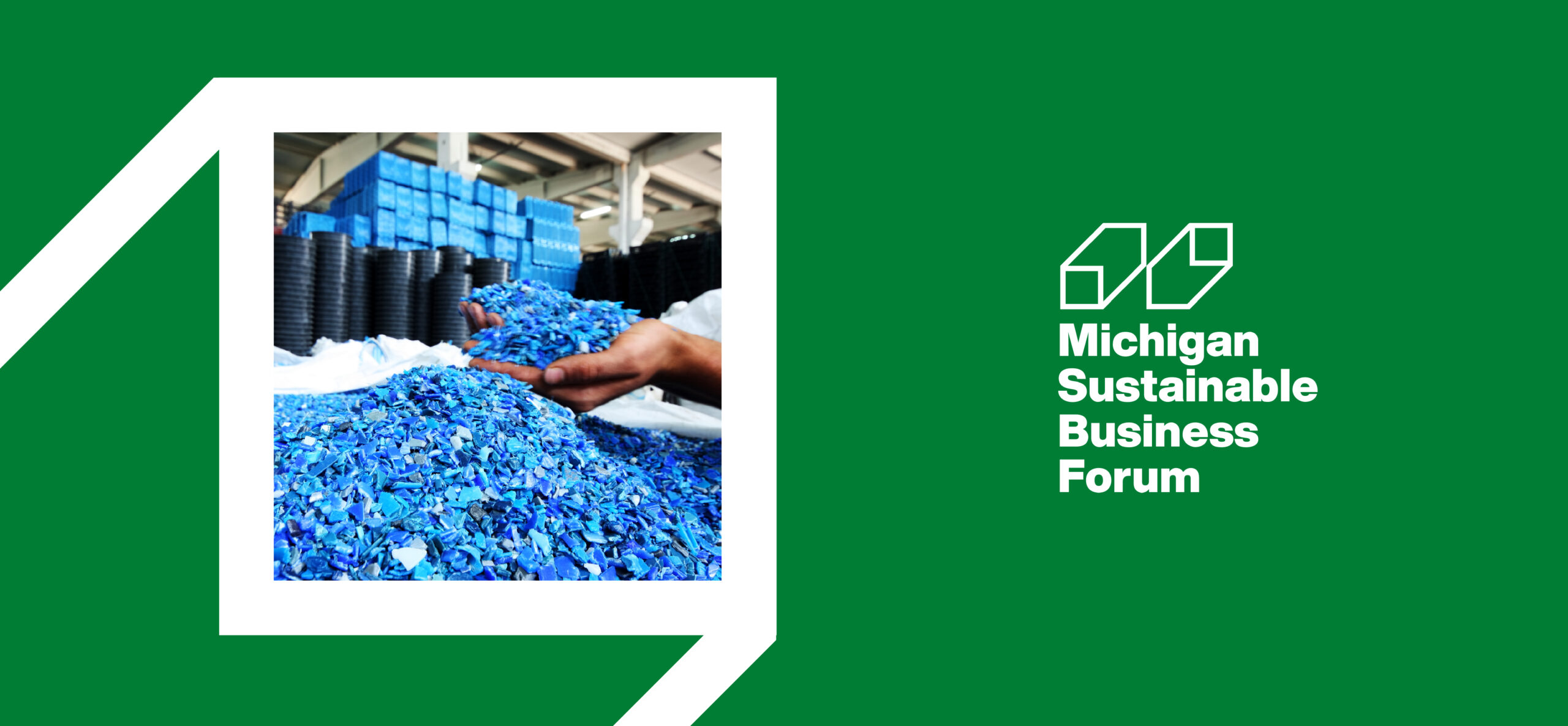
Why Recycling and the Circular Economy are an America First Strategy for Economic Development and Climate Action (Webinar Available)
February 12, 2026
Michigan Sustainable Business Forum hosted a roundtable of national experts that explored how circular and regenerative economy principles can advance America First priorities while promoting recycling, waste reduction, climate justice and other sustainability objectives.
The Trump Administration’s America First Priorities envision a domestic economy less reliant on international trade and labor. Its America First Trade Policy seeks to restrict access to American markets, incentivize onshore investments, reshape supply chains, and strengthen industrial and technological advantages through a variety of mechanisms intended to “support workers, manufacturers, farmers, ranchers, entrepreneurs, and businesses”.
Although President Trump and other America First advocates are seemingly skeptical of environmental stewardship and social equity as business priorities, these goals are not inconsistent with policies that center domestic production and promote national self-reliance. By leveraging circular economy principles in particular, sustainability leaders can advocate for policies and advance practices that accomplish shared objectives.
The timely discussion featured an all-star panel that includes
- Cheryl Coleman, Senior Vice President of Recycled Materials Association
- JD Lindeberg, President of Resource Recycling Systems
- Brenda Platt, Director of the Composting for Community Initiative at Institute for Local Self-Reliance
- Daniel Schoonmaker, Executive Director of Michigan Sustainable Business Forum
- Jon Smieja, Director of Circularity and EPR for WAP Sustainability, whose prior work as circular economy lead for Trellis Group inspired the topic.
“While sustainability leaders challenge the isolationism and nationalism underlying these policies, they also acknowledge the need to rethink globalization — particularly in the context of exploitative labor practices, environmental degradation and fragile international supply chains exposed during crises such as the COVID-19 pandemic,” says Smieja, who also co-led sustainable design initiatives while at Steelcase, one of the Forum’s 2025 Sustainable Business of the Year honorees.
“Reading The America First policy agenda, at times, is like reading a blueprint for a future circular economy (despite the authors having no such intention).”
Who Is This For: Sustainability practitioners and advocates, recycling and materials management professionals, environmental leaders, business leaders. Academics, decision-makers or influencers from manufacturing or retail supply chains, and public officials.
Learning Objectives:
- Understand Recycling Opportunities: Roundtable will discuss how recycling and sustainable materials management are America First accelerants that support domestic production, national self-reliance, and supply chain resiliency. It will also highlight how tariff uncertainty is impacting supply chains.
- Identify Shared Priorities: As implemented, America First is disrupting the clean energy transition and decarbonization efforts, but the administration’s desire to to minimize reliance on rare earth mineral imports through recycling, for instance, could be served by the battery recycling capacity critical to building a clean transportation sector. Workforce development, right-to-repair, local agriculture are all shared interests, among many other examples.
- Learn to Speak Sustainability for America First: Sustainable business and circular economy principles should be embedded within efforts to promote an American manufacturing renaissance. The webinar will introduce how sustainability arguments can be framed in language that people of many political persuasions can relate to and support (e.g.: eliminate waste, regrow local supply chains).
A Summary of Key Themes Discussed is Below
Aligning Circularity with Economic Development: Jon Smieja, Director of Circularity and Extended Producer Responsibility at WAP Sustainability, emphasizes that the circular economy aligns closely with broader economic goals, including workforce development and domestic manufacturing.
“A transition toward circularity isn’t just an environmental goal,” Smieja notes. “It’s a pathway to strengthen local economies through repair, refurbishment, and recycling industries.”
- By investing in reverse logistics hubs, localized manufacturing, and workforce reskilling, circularity can generate meaningful, high-quality jobs while stabilizing supply chains against disruptions such as pandemics or trade volatility.
- Positioning circular initiatives as long-term business investments, rather than simply sustainability programs, resonates across political and corporate audiences.
- When framed as strategies for risk reduction, supply chain stability, and economic growth, circular solutions attract broader support from stakeholders who might otherwise view environmental policies as politically polarizing or costly.
- The U.S. can draw lessons from European policy approaches, including Extended Producer Responsibility (EPR) and eco-design regulations. U.S. policy could incentivize product design for longevity, repair, and refurbishment, ensuring that circular principles are integrated throughout a product’s lifecycle.
Localized Infrastructure and Community Prosperity: Brenda Platt, Director of the Compost Community Initiative at the Institute for Local Self-Reliance, highlights the role of decentralized infrastructure in maximizing both social and environmental benefits.
- Local composting and organics recovery programs, for example, enhance soil health, sequester carbon, and support resilient food systems.
- These initiatives create far more jobs per ton of material than traditional landfilling or incineration, while also enabling community empowerment, education, and neighborhood revitalization.
- An overly consolidated waste management system, where a few large companies dominate collection and disposal, is less resilient and riskier. Such consolidation can suppress competition, inflate costs, and reduce local economic benefits.
- By contrast, decentralized circular systems foster small business innovation and keep valuable materials and economic value within communities.
Recycling as an Economic Engine: Cheryl Coleman, Senior Vice President of the Recycled Materials Association, notes that the recycled materials industry is a critical source of domestic supply for manufacturing and global trade.
- Beyond environmental benefits, recycling supports over 171,000 direct jobs and hundreds of thousands of ancillary positions across the U.S., from small enterprises to large corporations.
- The industry provides opportunities for workers across skill levels, including those reentering the workforce or with limited formal education, reinforcing the inclusive economic potential of circular practices.
Innovation and Regional Solutions: JD Lindeberg, President of Resource Recycling Systems, advocates for harnessing innovation at the regional level.
- Programs that support entrepreneurs developing reuse, remanufacturing, or waste prevention solutions can unlock local economic potential while ensuring initiatives are financially sustainable.
- Regional solutions are particularly effective in creating resilient circular systems that withstand external shocks, such as tariff fluctuations or global supply disruptions.
Framing Circularity for Broader Support
- Economic development, job creation, community resilience, and cost savings are often more compelling entry points than climate or environmental arguments alone.
- At the same time, environmental outcomes remain integral, whether through carbon sequestration, reduced landfill reliance, or improved local ecosystems.
As businesses, policymakers, and communities explore circular strategies, the convergence of economic, social, and environmental benefits demonstrates that circularity is not just an environmental imperative, it is a practical, scalable framework for sustainable growth and prosperity in the United States.