Michigan Dining Recognized as 2025 Michigan Sustainable Business of the Year Honoree
December 19, 2025
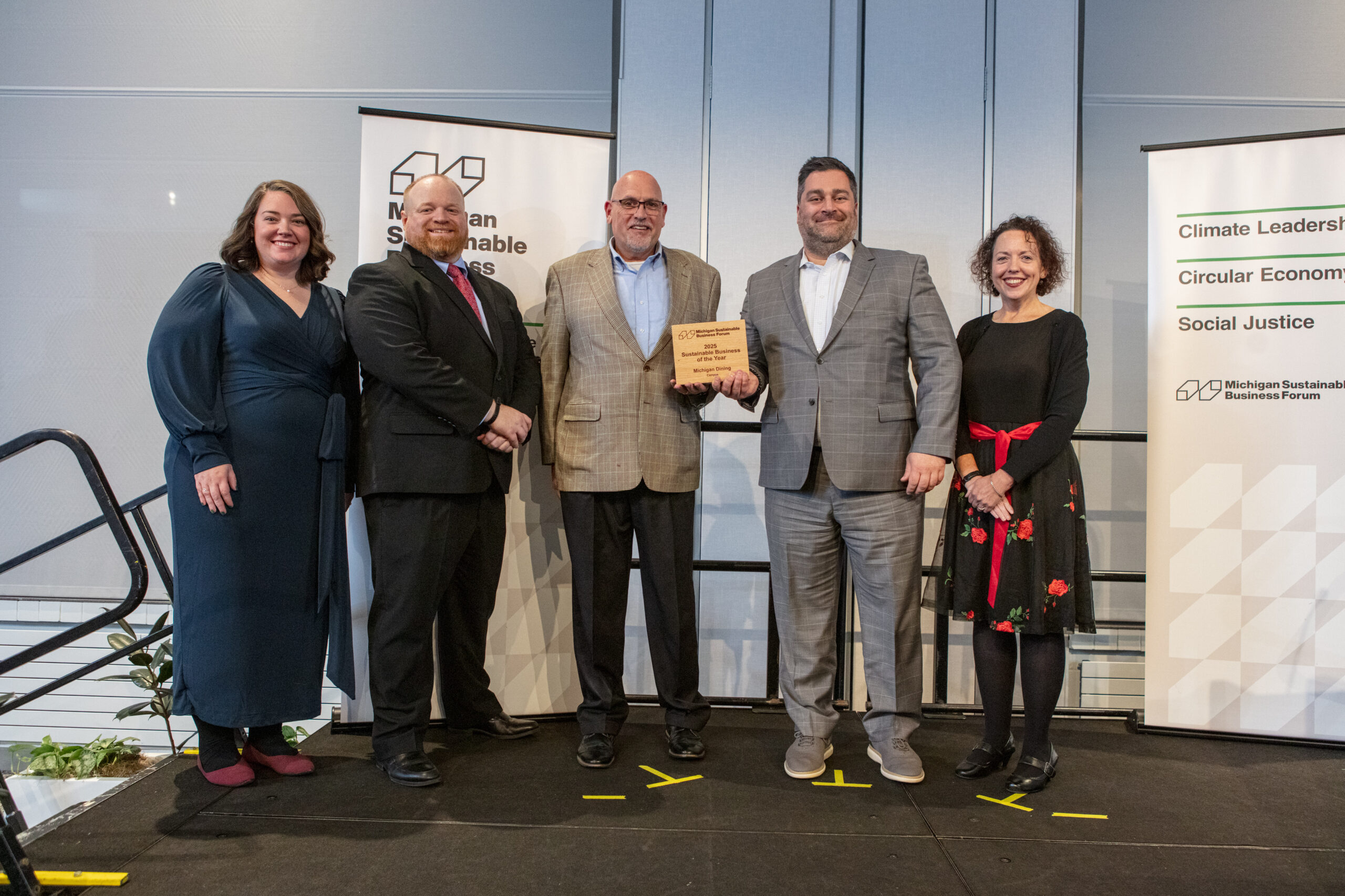
Michigan Sustainable Business Forum recognized the University of Michigan’s dining service as the winner in the Campus category
Michigan Sustainable Business Forum named Michigan Dining the winner of its inaugural Campus award during the Michigan Sustainable Business of the Year Awards at its 12th Annual Triple Bottom Line Bash in November at Frederik Meijer Gardens & Sculpture Park in Grand Rapids. The Campus category recognizes institutions of higher education and K12 schools for their sustainability accomplishments.
Michigan Dining has made dining part of the student learning experience, reinforcing the university’s sustainability goals and teachings. From carbon labeling menus to research-informed purchasing, every meal is an opportunity to lower carbon emissions and inspire change.
“Thanks to MiSBF and its members for this recognition. This award reflects the true dedication of our entire Dining team to live into our values each and every day, preparing the Leaders and Best for their future as global citizens” said Steve Giardini, Senior Director of Michigan Dining.
The signature event of the state’s sustainability community, this year’s Triple Bottom Line Bash hosted more than 350 professionals, supporters and their families to recognize businesses, institutions and professionals from around the state. This was the first year for the Michigan Sustainable Business of the Year Awards program, which had previously been organized as a regional event focused on western Michigan. Award winners and finalists were nominated by Forum members and selected by a committee of their peers.
Finalists in the category included Michigan Dining and the Michigan State University Surplus Store and Recycling Center.
“This year’s nominees included a dining operation with a best-in-class commitment to sustainability and sustainable food systems, and what might just be the best on-campus recycling program on the planet,” said Daniel Schoonmaker, Executive Director of Michigan Sustainable Business Forum. “We are proud to recognize these national leaders who are working to embed sustainability into the educational experience.”
Progress on Climate Solutions
MDining has made meaningful progress towards decarbonization goals through several initiatives. Working with Andrew Jones, a public health nutritionist in the School of Public Health and Nutritional Sciences, it began as a carbon labeling initiative that highlighted the emissions footprint of its menus. Jones conducted a study to determine if purchasing behavior could be changed through “nudge” techniques, which was supported with educational marketing and additional information online. After the study, MDining continued the labels to provide diners the information necessary to balance environmental impact in their food choices.
Another initiative is actively reducing red meat consumption and increasing plant-based food choices offered to students. This includes Sustainable Mondays, where no red meat is served, and the introduction of lower-carbon burgers that incorporate mushrooms. It has also committed to a goal of a 55% plant-based menu through the Humane World for Animals organization. It has currently achieved 48 percent.
Recognizing that dairy was one of the largest contributors to emissions in café operations, MDining catalyzed a shift toward sustainability by making oat milk the default in all milk-based beverages. This initiative not only reduced environmental impact but also set a precedent for sustainable food practices across campus dining. After implementation, 46 percent of customers retained the oat milk default, while 54 percent opted for alternative milks or no milk at all. Despite a 25 percent increase in beverage sales in Fall 2024 compared to Fall 2023, milk-related emissions fell by approximately 20,000 kg of CO2. This reduction is equivalent to avoiding the burning of 20,000 pounds of coal or preventing 50,000 miles of driving in a gasoline-powered car.
Food Systems Leadership
Michigan Dining has demonstrated leadership through comprehensive initiatives that reduce food loss and waste, promote sustainable practices, support food system workers, and address food insecurity.
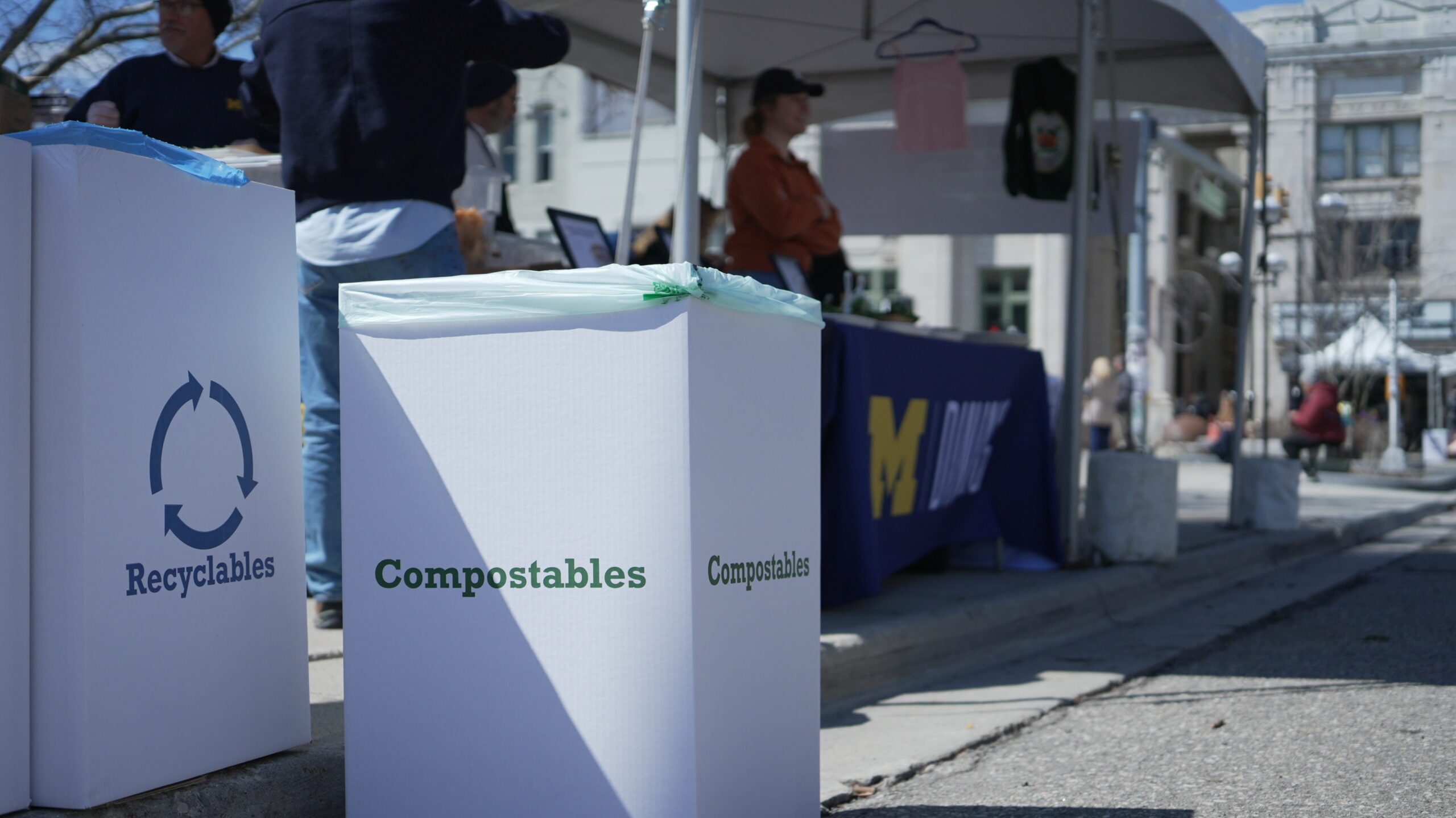
In 2019, MDining transitioned from paper products to fully compostable packaging and launched a robust composting program that includes both back-of-house and front-of-house operations. Building on this, Michigan Catering pioneered Zero Waste events, educating the campus community on sustainable practices and directly supporting the university’s waste diversion goals. In its first year alone, more than 300 events were supported, including the annual Zero Waste Picnic at New Student Convocation, which welcomes over 8,000 incoming students. This signature event not only models sustainable behavior but also features locally sourced, sustainable food, instilling a culture of environmental responsibility from day one.
During the pandemic, MDining introduced a reusable container program to reduce single-use compostables. This program continues today, offering students convenient, sustainable options, especially helpful for those needing meals outside of traditional dining hours.
Michigan Dining has also taken significant steps to reduce food waste and combat food insecurity. In partnership with the Food Recovery Network, a student-led initiative, surplus food from dining halls is gleaned and redirected to community members in need. Since 2012, more than 58,000 pounds of food, the weight of six adult African elephants, have been recovered, providing over 100,000 meals.
As steward of the Maize and Blue Cupboard, MDining provides vital support to this student-run food resource. In addition to logistics, training, and administrative assistance, Dining staff offer chef demonstrations, nutrition education, and marketing support. These efforts empower students to support one another while building essential skills for healthy living. Research shows that students who eat and rest well perform better academically, maintain healthier lifestyles, and are more likely to graduate—making this work integral to student success.
Celebrating Food Workers
In Winter 2024, Michigan Dining launched “The Humans Who Feed Us” within residential dining facilities, a campaign that uplifts the voices of migrant farmworkers and draws attention to their vital, often unrecognized contributions to our campus food system. Building upon this, our own series, “People Who Feed Us,” features in-depth interviews with Michigan Dining team members, translated into nine languages to ensure inclusivity and accessibility.
The Triple Bottom Line Bash began in 2014 to celebrate the 20th anniversary of West Michigan Sustainable Business Forum. The organization rebranded as the statewide Michigan Sustainable Business Forum at the event in 2024.
Other winners included Meijer (Large Company), Revolin Sports, (Small Business), City of Ann Arbor (Public Sector), Green Living Science (Community Organization, Supermercado Mexico (Food Systems) Edison Community Partners (Services & Consulting), Recycler of the Year Unlimited Recycling, Inc. and Manufacturer of the Year Vantage Plastics.
Michigan Sustainable Business Forum promotes business practices that advance climate leadership, social justice and the creation of a circular economy. Through its membership program, the Forum is Michigan’s leading organization for beyond-compliance sustainability practitioners, serving its most recognizable brands, largest employers and most innovative entrepreneurs, advocates and educators, as well as the public sector. Through its campaigns and advocacy, it is contributing to a future where greenhouse gas emissions in the atmosphere are declining and Michigan is a center of expertise for sustainable business.
Learn more about Michigan Sustainable Business Forum at misbf.org.
Learn more about Michigan Dining at dining.umich.edu.