
Sustainability Leaders on Michigan’s Lakeshore Share Unwavering Commitments to Climate Action at MiSBF Forum
October 1, 2025
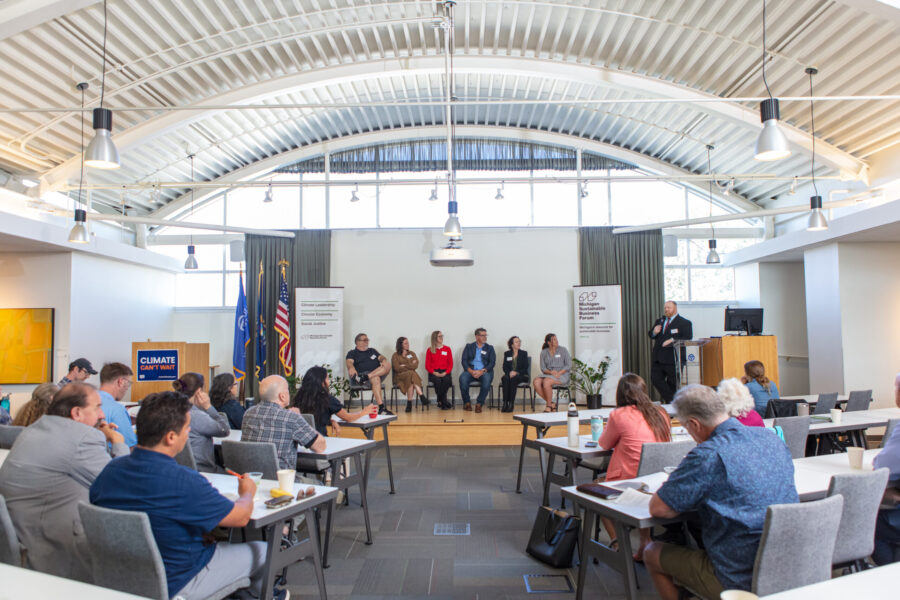
On Wednesday, September 17, attendees gathered at the Muskegon Innovation Hub to hear from public officials and business leaders about the state of climate action at the Michigan Sustainable Business Forum’s Lakeshore Climate Forum.
Speakers addressed climate action programs at the state and local levels, community energy plans, renewable energy development, and emissions and food waste reduction strategies – all of which are moving forward despite the backslide on climate issues in Washington.
Learn about more upcoming events advancing sustainability in Michigan.
Local and State Officials Acknowledge Challenges, Offer Encouragement
Mayor Ken Johnson (Muskegon) opened the event, celebrating the attendees and speakers for their contributions to long-term economic growth in Michigan.
“At a time when federal leadership has unfortunately sought to derail renewable energy investments and climate programs, gatherings like this have even greater significance.”
Johnson went on to highlight the city’s accomplishments in sustainability, including the restoration of Muskegon Lake, which is soon to be delisted from the Environmental Protection Agency’s “Areas of Concern.”
“Local governments, non-profits, and businesses alike can act boldly, which has gained even greater importance in the face of national headwinds.”
Julia Field, Deputy Climate and Energy Advisor at the Michigan EGLE Office of Climate and Energy, presented on the MI Healthy Climate Plan as an opportunity to address environmental justice, create jobs, and support cleaner air across the state.
Later, in the panel discussion, Field responded to questions regarding the regressive actions against climate change solutions in Washington: “We created the plan without knowing the IRA and the BIL would exist…because we started writing the plan without that money in mind, we’re going back to those original organizing principles.”
Damaris Potter, Climate Action Planner at the Grand Valley Metropolitan Council, shared an update on the West Michigan Healthy Climate Plan, which seeks to bridge the gap between rural and urban areas in the four-county region: Montcalm, Ionia, Kent, and Ottawa.
“Being in this field, sometimes we can get into our echo chambers. We see the same people a lot, hear the same ideas, and so this was really our way of putting boots on the ground, meeting people where they’re at,” Potter said.
Community Energy Plans on the Lakeshore Provide Instructive Insights on Local Climate Action
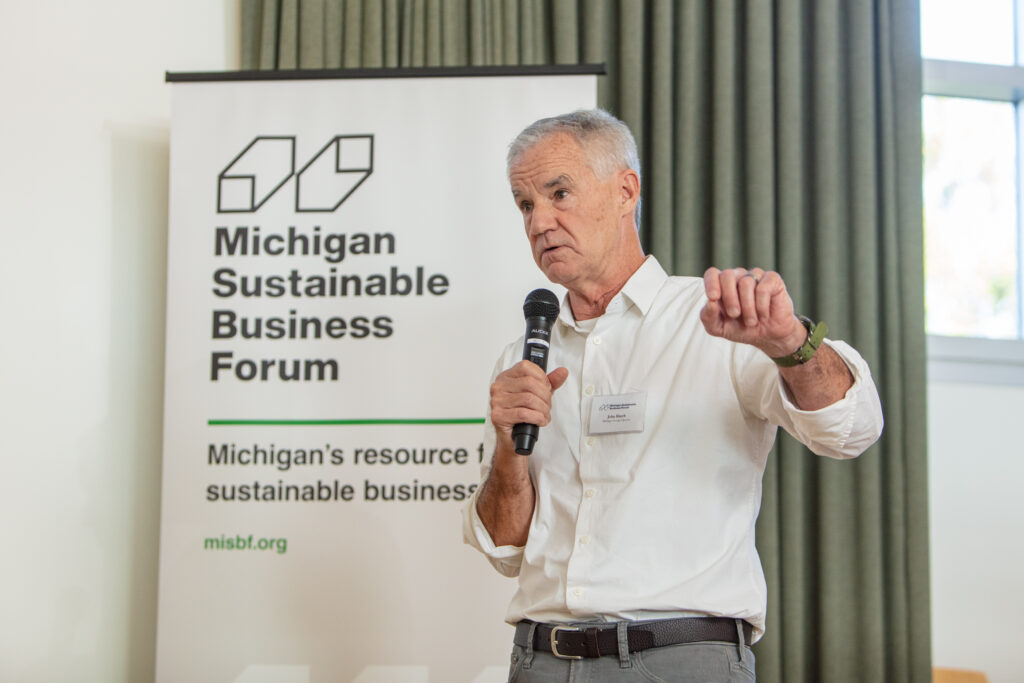
John Kinch, Executive Director of Michigan Energy Options, shared insights from the design and execution of the Northwest Ottawa County Community Energy Plan, outlining three key qualities: funding, political will, and a friendly “incumbent” or utility.
Kinch described community energy plans in terms of investment: “It’s a hedge against rising energy prices. It’s a hedge against more impactful storms. It’s a hedge against climate change. It’s a way for you to provide resilience in your local community that you have control over.”
He also highlighted considerations addressing constraints, including gaps in data sets and local capacity: “You’ve got to have the capacity to actually carry something out. Too often, these kinds of plans end up on the shelf somewhere, even though they’re well-intended.”
Andrew Reynolds, CEM, the Efficiency Programs Manager at the Holland Board of Public Works, presented achievements and lessons from the city’s Community Energy Plan, one of the first and most progressive in the state.
Regarding greenhouse gas emissions inventories, Reynolds encouraged sustainability professionals in the room to go beyond more easily accessible data: “Don’t ignore emissions that you can’t measure or claim. We incentivize things like lawn tools because we know they’re bad emitters, even though we don’t currently track that in our overall community emissions.”
During the panel discussion, Kinch made clear the devastating impact of actions in Washington that froze or eliminated funding for climate action programs on the local level.
“The IRA was the single biggest investment in green energy we’ve ever seen as a nation. By my watch today, I think we’ve had about a $25 billion claw-back by the Trump administration for grants that will affect us.”
Sustainable Business Leaders Weigh In On Changing Political Tides with No Plans to Abandon Climate-Smart Solutions
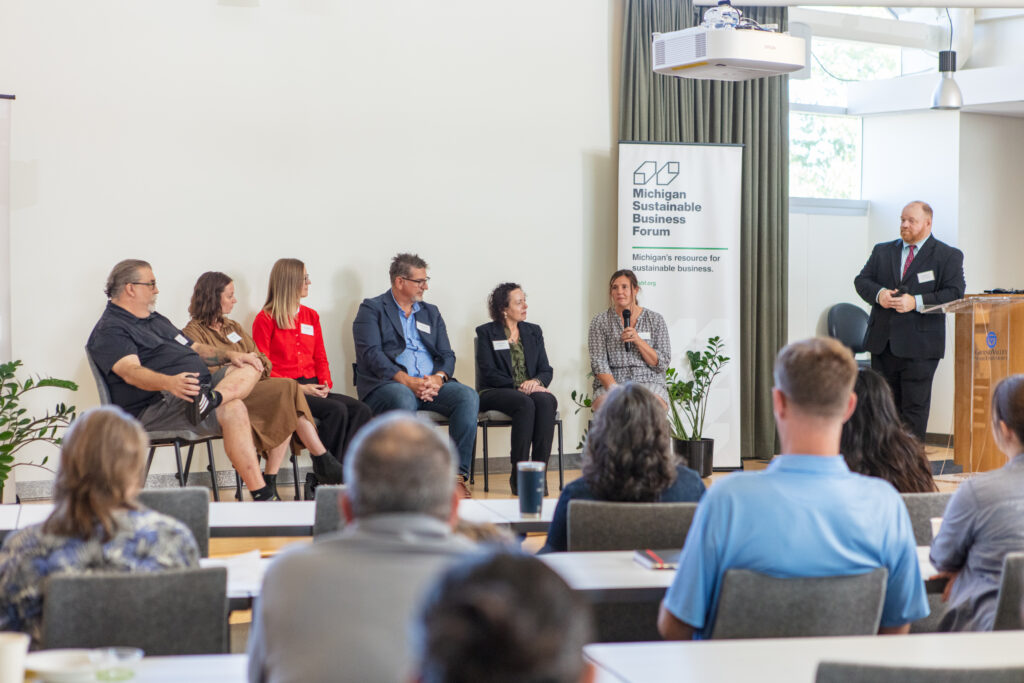
Emily Prehoda, PhD, Chief Operating Officer at Chart House Energy, described how eroding federal support for clean energy development affects business on the ground and local economies: “When you initially talk to potential customers or even other contractors, their initial reaction is that this is going to be devastating for the clean energy industry and we might see a slowdown.”
However, the urgency and public nature of the Trump administration’s move to eliminate IRA funding may have the unintended consequence of demonstrating just how popular support for renewable energy is, as businesses and residents rush to complete projects before federal incentives disappear. Incentives remain available for residential solar developments through the end of 2025, with incentives for commercial properties available through 2027.
“It’s going to be a mad dash to try to get projects done by the end of the year,” Prehoda said, “We’re seeing a lot more residential folks reaching out to us. That’s not our core business, so we’re actually trying to pivot to help them get their projects done by the end of the year because those federal incentives are going away for them in December.”
Greta Jost, Senior Sustainability Specialist at Haworth, shared how her team approaches the ever-changing landscape for organizations committed to a net-zero future. “How can we be a community member, find partners upstream and downstream from us that still want to move on, and leverage those opportunities regardless of the political climate?”
Jost emphasized flexibility as a key characteristic of the company’s sustainability and renewable energy strategy, saying, “Whether it’s assessing onsite, or taking advantage of credits while they’re there, or buying renewable energy from the market, we can refine as we go.”
Scott Charon, Senior Manager of Sustainability and Reporting at MillerKnoll, echoed Jost’s persistence and optimism: “We are really moving forward with our goals, and that’s full speed ahead.”
Still, volatility caused by the federal administration’s actions, including the unpredictable tariff regime, remains a key concern for many business leaders. “Uncertainty in the markets has a direct impact on being able to trade the commodities that we produce out of all the recycled materials that we collect. Being able to navigate that is what makes PADNOS a successful company, but it has been extreme volatility,” said Kari Bliss, Principal of Sustainability at PADNOS.
Brittany Goode, Sustainability Manager at Aldea Coffee, has similar concerns: “The tariffs are affecting us an incredible amount. We paid an extra 30 cents per pound on our green coffee this year just to get it into the U.S.”
Garry Boyd, Owner of the Unicorn Tavern, added that 75 percent of his restaurant’s suppliers, many of whom are based locally, have also been negatively affected by tariffs.
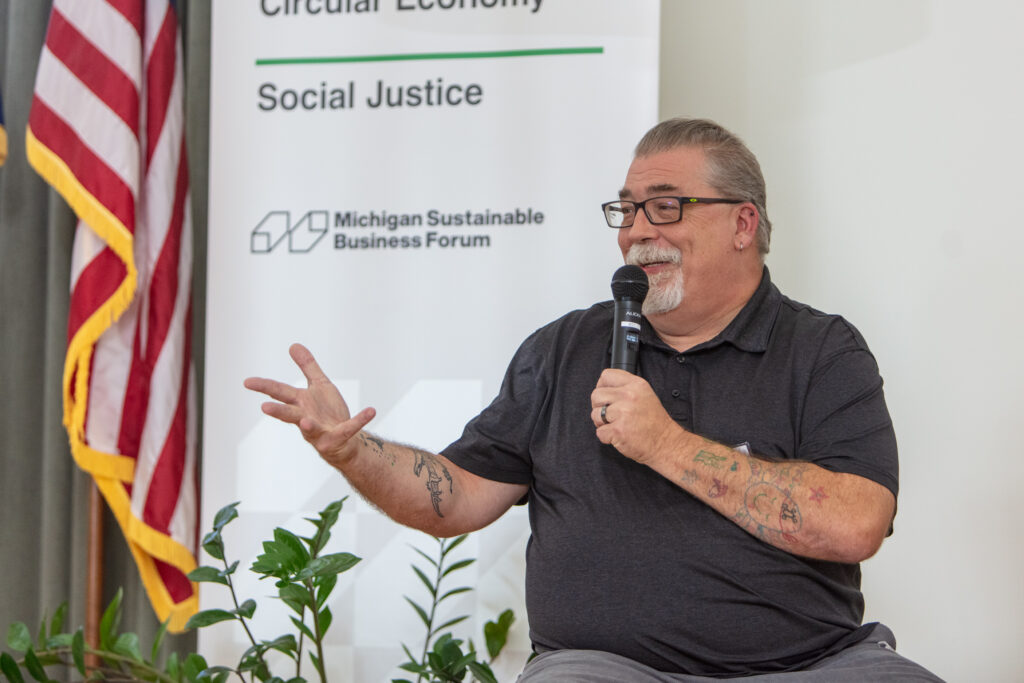
Local Food Service Businesses Lead the Lakeshore’s Path to Zero Waste
Both Aldea Coffee and Unicorn Tavern continue to find innovative ways to make their operations more sustainable and share best practices with peers.
Goode described Aldea Coffee’s waste reduction initiatives, including innovations in packaging and to-go cups, allowing customers to bring reusable mugs, and collaborating with other companies in the industry to encourage similar initiatives: “The Schuil Coffee Company in Grand Rapids somehow recognized that we were doing a lot of sustainability initiatives, drove to Grand Haven to sit with my boss and me, and just hear what we’re doing. And so we are making an impact, and it is moving, rippling through the state.”
Boyd shared the origins of his business’s approach to sustainability: “We started our waste diversion program after an employee started a petition against me. Because I told him we couldn’t do anything about where our trash was. And he dared me, and we figured it out.”
In 2024, the Unicorn Tavern diverted 80% of its waste from landfill by including the restaurant’s entire team in composting and recycling efforts. “Every person employed at Unicorn Tavern has to participate because there’s no other option,” said Boyd.
Boyd also shared how sustainability initiatives can gain traction with just a few key actors modeling positive action: “A goal of mine is to get the business community recognized for what we’re doing because it’s really easy once you start…When the Grand Haven Public Schools reaches out and says, ‘hey, our chef wants to talk about composting in the food program here,’ that, to me, is a win.”
Boyd closed the panel with a challenge for his county: “Can we work with Ottawa County [to be] the first county in Michigan to allow you to bring your own to-go stuff to take your food home with you?”