
Leadership on Climate and Food Starts With Business
August 1, 2025
At a time when technology and supply chains are finally aligning to advance major improvements in sustainability for the private sector, new challenges have arisen at every level of government to create an uncertain landscape for investments in climate action, food systems and the circular economy.
Only six months removed from an administration that birthed the largest public sector investment in climate action and a notable increase in rules and regulations designed to promote emissions reductions and pollution prevention, the federal government has rapidly shifted priorities and is driving an unprecedented reconsideration of the country’s decarbonization and environmental justice commitments. At its Fifth Annual Grand Rapids Sustainable Business Policy Forum on Monday, August 11 at the Bissell Treehouse at John Ball Zoo, Michigan Sustainable Business Forum will be discussing how Michigan is at a pivotal point in its climate and economic transition between industry initiatives, federal investment, the Mi Healthy Climate Plan, circular economy investments by state and local governments, and municipal leadership such as the proposed Grand Rapids Climate Action and Adaptation Plan.
Michigan was a top recipient of direct investment from the Inflation Reduction Act, with approximately $28 billion in investment, driving momentum in emerging industries while investing in under-resourced neighborhoods. Improved air quality regulations were helping to accelerate the electric vehicle transition and create supply chain opportunities. Electrification and weatherization investments were creating opportunities for contractors and suppliers.
It has since seen a constant barrage of funding delays, interruptions and cancellations. More than a million dollars worth of food allocated for local food banks were lost earlier in the year, with agencies forced to seek emergency funds. More than $60 million in climate justice grants were cancelled through just one action this past spring, as the EPA rescinded the Community Change Grants it awarded to Benton Harbor, Detroit and Kalamazoo. The One Big Beautiful Act will sunset incentives for clean energy and transportation.
State and local leaders provide reason for optimism
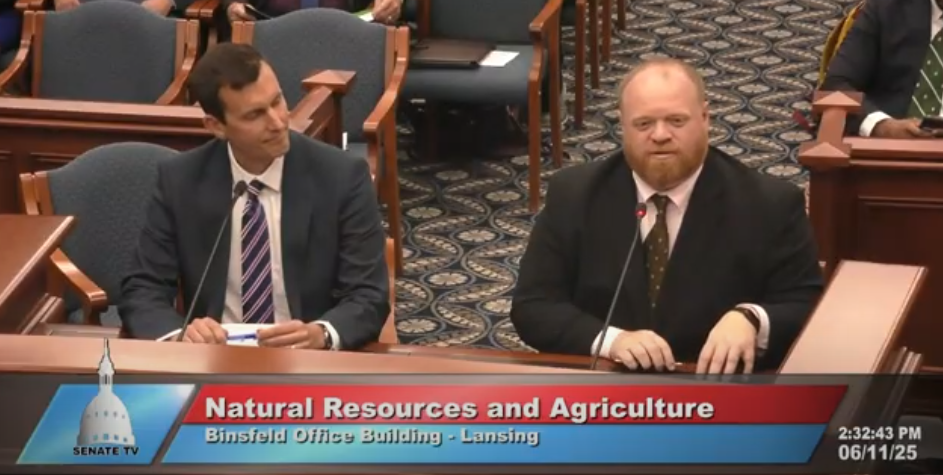
Across four sessions and a networking hour, the Policy Forum will highlight the importance of local action and business leadership, and the emerging impact of recent federal funding freezes, proposed budget cuts, and regulatory changes (such as the EPA’s recent reconsideration of the endangerment finding and air pollution standards.) Ann Larson, Deputy Director for the Michigan Department of Environment, Great Lakes and Energy, and Ed Rivet, Executive Director of Michigan Conservative Energy Forum, will be joined by a bipartisan panel of Greater Grand Rapids state legislators, including Representatives Carol Glanville, Kristian Grant, John Fitsgerald, Bryan Posthumus, and Stephen Wooden.
The delegation will discuss how the state will continue to advance the Mi Healthy Climate Plan, the new renewable energy laws and materials management planning, while deploying hard-won program funding and developing new legislation and regulatory frameworks.
- Can Michigan keep momentum for its energy transition and environmental justice commitments?
- How can Michigan better partner with communities and constituencies skeptical of clean energy and climate investments?
- What opportunities do the state’s sustainability programs create for farms and small businesses benefit from Michigan’s sustainability
- How can the state ensure its emergency food system has adequate supply to meet growing needs despite funding cuts?
- How is the state working to close the loop through materials management and address methane emissions?
While a newly divided state legislature, pending gubernatorial election, and evolving relationship with federal partners has changed the political landscape in Lansing, there is ample room for optimism at the local level despite volatility. Earlier this year, City of Grand Rapids shelved its Climate Action and Adaptation Plan after a two-year planning process. Chief Sustainability Officer Annabelle Wilkinson will provide an update on the CAAP and the city’s sustainability initiatives, including new progress on the solar development long planned for the former Butterworth landfill. The City Commission is scheduled to vote on the CAAP at its meeting the following day.
Also speaking is Rocio Rodriguez, Executive Director of the Roosevelt Park Neighborhood Association. MiSBF was a founding member of the Coalition for a Safe & Healthy Roosevelt Park Neighborhood alongside the Grand Rapids Urban Core Coalition. Since 2022, the coalition’s efforts have led to a 30 percent reduction in non-local heavy truck traffic in the neighborhood.
Learn more about the Policy Forum and register here.

Opportunities for business and community leaders to support federal climate action
As has been widely reported, earlier this week the EPA announced that it would begin a process to rescind the Endangerment Finding, the decades-old scientific consensus that provides the basis for the agency to regulate greenhouse gas emissions. In the same proposal, the Trump administration aims to roll back vehicle pollution standards, despite the current rules cutting pollution, improving health, and saving consumers money.
In 2023 the Forum supported a plan from the EPA to develop new carbon pollution standards for coal and natural gas-fired power plants that the agency estimated would reduce pollution and deliver up to $85 billion in climate and public health benefits over the next two decades. At the time, the rules appeared to align with existing commitments from Michigan’s utilities. The agency worked closely with environmental justice communities to develop the new standards, which will have a dramatic impact on public health, and prioritized a transition that would make businesses and communities confident that the grid is reliable and resilient.
Repealing the carbon plan is part of the EPA’s effort to end regulation of greenhouse gas emissions. There is currently a comment period open for professionals interested in commenting on the decision to eliminate the rule. The Climate Action Campaign has created an easy-to-navigate form to do so, which can be found at this link.
There is also a related standard with a comment period currently open as well, Mercury and Air Toxics Standards, which regulates Mercury emissions from power plants. The decision to pull down these rules was announced at the same time and there is also a comment form available here.
Both comment periods end on August 6. Historically, input from business leaders is given greater weight in these decisions.