

How Grand Rapids’ Climate Actions Reduce Emissions and Prioritize Equity
July 21, 2025
Grand Rapids has been a national leader on climate action among mid-sized US cities for well over a decade and the many years of data gathering and climate action are paying off.
In 2021, City Manager Mark Washington announced two carbon reduction goals for City operations: an 85 percent reduction in carbon emissions by 2030 and carbon neutrality by 2040. In addition, the recent Grand Rapids Climate Action & Adaptation (CAAP) plan sets further community-wide science-based targets:
- 62.8% per capita GHG reduction community-wide by 2030 (from 2019 emissions)
- 100% per capita GHG reduction by 2050 (from 2019 emissions)
City Operations Lead the Way on Climate Action
To achieve these targets, the Grand Rapids Office of Sustainability (OS) is collaborating with several institutions, such as the National Renewable Energy Lab (NREL) and Michigan Green Building Collaborative or MIGBC (formerly known as the U.S. Green Building Council of West Michigan), to benchmark the City’s year-over-year reduction in energy consumption.
Currently, 60 municipal buildings are enrolled in MIGBC’s Automated Benchmarking System that tracks and analyzes their energy footprints. Kevin Greene recently joined the OS as the Energy & Carbon Specialist to advance the City’s greenhouse gas (GHG) reduction and energy efficiency goals.
Emissions reduction from the City of Grand Rapids’ water utility, municipal buildings and fleet vehicles were 30 percent between 2008 and 2020, and is projected to reach a 47 percent reduction in 2025 from 2008 baseline data.
This progress can be attributed to significant emissions-reducing projects, such as the introduction of zero-emissions vehicles to the City’s fleet and the construction of a biodigester at the Water Resource Recovery Facility (WRRF). Constructed between 2017 and 2021, these large tanks contain microorganisms that consume organic solid waste and capture harmful methane gas before it can enter the atmosphere. This “biogas” is refined, compressed, and then consumed by The Rapid’s fleet of buses as an alternative to dirtier, diesel fuel.
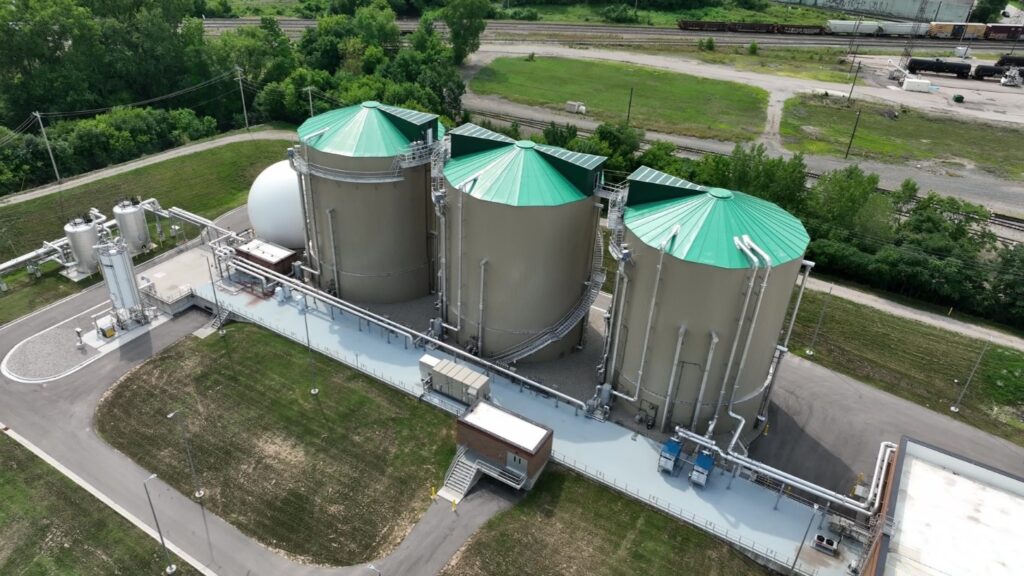
The City anticipates a further reduction in electricity consumption, which contributes over 75 percent of municipal GHG emissions, after installing a one-megawatt solar array at the Lake Michigan Water Filtration Plant, 429 solar panels at 1900 Oak Industrial Drive, and having completed a third biodigester tank at the WRRF in 2022. The City also converted more than 18,000 streetlights to LED in 2024 and is currently transitioning half of the City’s fleet to electric or hybrid vehicles in 2025.
While impressive, these emissions reductions come from municipal operations which represent only a small fraction, approximately 2.5 percent, of the GHG emissions within Grand Rapids. The remaining 97.5 percent are produced community-wide from buildings, transportation, and the energy that sustains the city.
>> For a detailed breakdown of the GHG emissions see Appendix C: Technical Analysis of the CAAP.
The City will work collaboratively with Grand Rapids’ community to achieve their science-based targets by improving the current building stock and encouraging sustainable, equitable, future development.
Carbon emissions from buildings account for nearly 30 percent of carbon emissions nationwide. Of the emissions from Grand Rapids’ buildings, 42 percent come from commercial buildings over 10,000 feet and 39 percent come from single family homes.
Updating buildings to reduce emissions can be costly — high up-front investments could put undue burdens on small businesses, renters, and homeowners, particularly those in under-resourced communities who are already disproportionately impacted by climate change.
“This action plan really is going to be… interwoven through all of our community because it’s already what people want and already what people are doing,” says Kat Hart, Education and Engagement Coordinator at the city’s Office of Sustainability. “Seeing that kind of integrity and intentionality for this plan has been really amazing.”