
How Grand Rapids’ Downtown Market Demonstrates Leadership in Stormwater Management Through Green Stormwater Infrastructure
March 12, 2018
The Grand Rapids Downtown Market is a nationally recognized example of how thoughtful stormwater management and water efficiency can be integrated into a dense urban setting. Designed in 2012 by Fishbeck, Thompson, Carr & Huber (FTC&H), the Market prioritized green stormwater infrastructure from the outset, helping it earn LEED Gold certification and making it one of the first LEED-certified urban markets in the United States.
Located in the Lower Grand River Watershed with direct drainage to the Grand River, the 132,000-square-foot mixed-use facility demonstrates how infiltrating stormwater where it falls can protect water quality while supporting redevelopment in downtown Grand Rapids.
“When it comes to water, we make sure no drop is wasted,” said Steve Teitsma, formerly of FTC&H, who helped design and implement the Market’s stormwater systems.
Green Stormwater Infrastructure Built Into Every Layer
Stormwater management strategies are visible throughout the Downtown Market site. A rain garden in the parking lot, planted with native species such as purple coneflower, black-eyed Susan, and common milkweed, serves as a critical bioretention area. These deep-rooted plants infiltrate and retain large volumes of stormwater, reducing runoff into the Grand River. While early challenges included invasive plants, ongoing maintenance and species replacement have allowed the garden to thrive.
Before construction, the Downtown Market site was classified as a brownfield, contaminated by years of industrial dumping. Groundwater was pumped and remediated through the municipal sewer system until the site met safety standards for redevelopment. Today, the Market stands as a catalyst for neighborhood revitalization, sparking investment in surrounding properties while restoring ecological function.
Teitsma emphasizes that while green infrastructure can present upfront costs, the long-term environmental benefits and infrastructure resilience make it worthwhile. He advocates for stronger policies and incentives that encourage stormwater infiltration at the site level to protect downstream water quality.
The north parking lot features permeable pavement underlain by a stone basin that functions as a catchment system. Along Ionia Avenue, a tree-lined streetscape intercepts runoff through leaf canopy and root systems, while integrated planter beds provide irrigation and additional water retention.
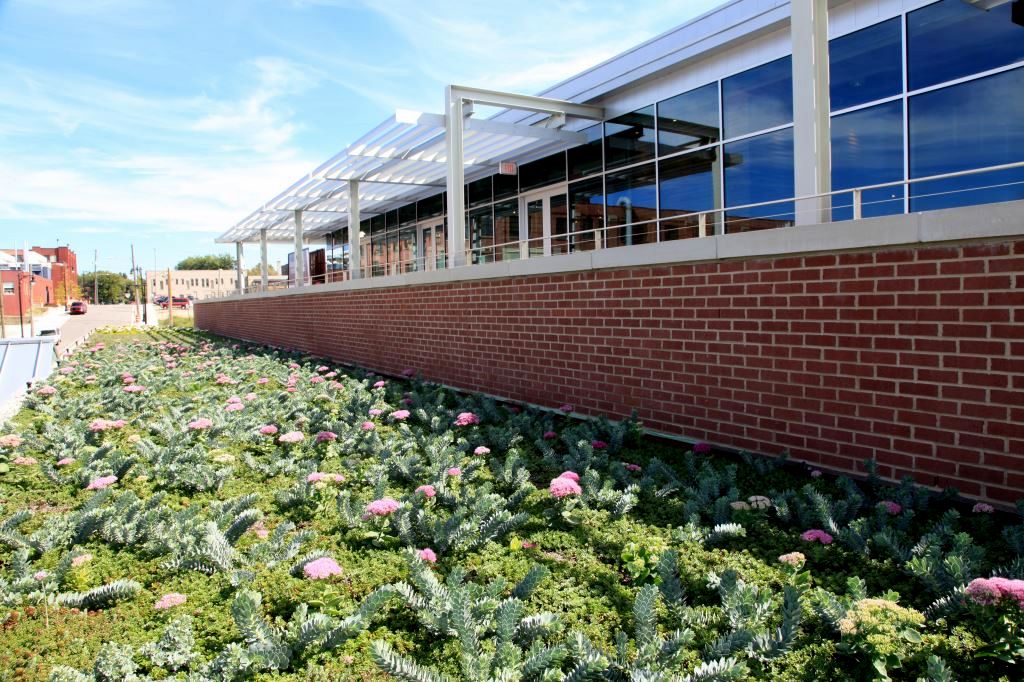
Atop the Market are two green roofs that act as sponges—absorbing rainfall, mitigating runoff, filtering air pollutants, and releasing oxygen. Inside the building, sustainability continues through live plant walls and a year-round second-floor greenhouse.
The greenhouse is irrigated entirely by a 4,000-gallon cistern that captures overflow rainwater from the roof. The stored water is filtered and pumped back into the building through an overhead irrigation system, creating a closed-loop approach to water reuse.
About Grand Rapids Downtown Market
The Grand Rapids Downtown Market is a mixed-use food, education, and entrepreneurship hub featuring a 20+ vendor market hall, restaurants, an Incubator Kitchen, rooftop greenhouses, and the nation’s first kid-friendly demonstration kitchen. Built to revitalize a formerly underutilized site, the Market continues to anchor redevelopment in downtown Grand Rapids.
About Green Stormwater Infrastructure
Green stormwater infrastructure (GSI) uses natural systems such as rain gardens, permeable pavement, green roofs, and cisterns to manage stormwater on site. These practices reduce flooding, improve water quality, and restore ecological function while supporting urban development.