Campaign Launches to Improve Food Rescue in Michigan
A recent grant from the Michigan Health Endowment Fund is supporting the development of a campaign to increase the amount of donated food in the state’s charitable food system.
The Michigan Food System Waste Reduction Roadmap Initiative created a plan for the state to reduce food loss and waste by half, the goal recommended in the MI Healthy Climate Plan. The 2024 report highlights that food rescue is one of Michigan’s most successful strategies for addressing food loss and waste, despite considerable operational barriers, an environmental success story that benefits efforts to address hunger and promote justice.
To keep pace with the 50% Reduction Goal, the amount of rescued food in the charitable food system must double, along with the support systems that ensure food donations are distributed and consumed. The Roadmap makes several recommendations for public policy and program improvements to improve food rescue in Michigan, at a variety of scales, with newly available data suggesting that edible food disposed of in the state’s landfills from commercial businesses and produce left unharvested on its farms would be enough to feed the 1.3 million people that the Michigan Food Security Council estimated face food insecurity.
The Double Food Donation campaign will create a network to advance the Roadmap recommendations while convening partners for peer learning and collaboration. This will complement existing statewide and regional initiatives through a unique multidisciplinary coalition targeting institutional, agency, and business stakeholders in or adjacent to the emergency and charitable food systems. The campaign will formally launch at the Advancing Food Rescue Summit at the Capitol Building next week Tuesday, October 28.
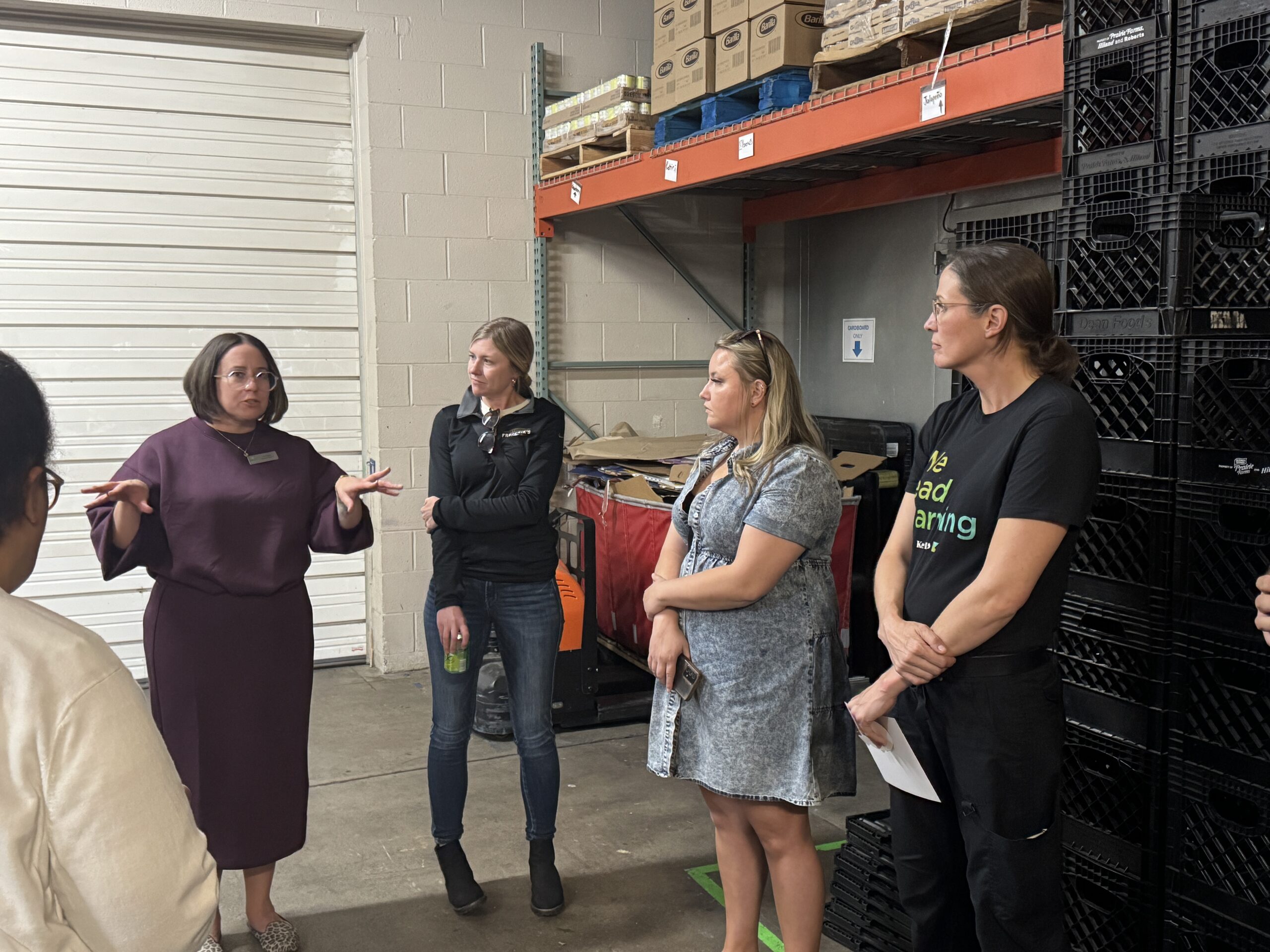
Pictured above: The campaign collaborated with American Culinary Federation of Greater Grand Rapids on an event at the Community Food Club in Grand rapids discussing barriers to food donation and highlighting the food club model.
Addressing Barriers to Food Rescue and Improving Efficiency of Food System
Facilitated by Michigan Sustainable Business Forum, it is led by an advisory council composed of community organizations and food system advocates from across the state, leading food businesses, and the Michigan Department of Health and Human Services, Michigan Farm Bureau, Center for Regional Food Systems at Michigan State University, Michigan Department of Environment, Great Lakes and Energy, and the West Michigan Food Processing Association.
“With recent increases in grocery prices, disruptions in federal funding, and other pressures, the charitable food system will have an increased demand for donated surplus food,” said Daniel Schoonmaker, Executive Director of Michigan Sustainable Business Forum. He noted that from an operational standpoint, managing rescued produce and prepared food can be more challenging than purchased food: supplies are inconsistent in composition and frequency, may not align with member preferences or healthy food objectives, or require portioning, packaging or processing to be distributed.
“The rescue operations capable of recovering perishable food on short notice are uniquely qualified. We are working to uplift those organizations and provide them the resources they need, and to ensure food businesses have all the support they need to partner with these organizations to find better uses for their surplus food.”
The campaign will focus on the following objectives:
- Launch a peer network that strengthens food rescue in Michigan through education, by seeding capacity for practice innovation, through collaboration, and policy action.
- Assess current capacity and characterization of food rescue in Michigan.
- Identify new sources of donated food and address barriers to rescue.
- Develop a policy platform with consensus support from network participants, likely to include, among other items, a more robust tax credit for food donation in Michigan.
Michigan Businesses Waste Enough food to Feed Every Hungry Family in the State
At next week’s summit, the campaign will introduce initial findings from its first year of stakeholder engagement and begin a series of educational and network convenings, data collection specific to food donation, rescue and upcycling, and development of matchmaking resources for food supplies and financial support. Representatives of approximately 60 organizations from across the state are expected to be in attendance.
“Food rescue is one of the best win-wins we have. Every pound saved from the landfill cuts waste and emissions while making sure more Michigan families have healthy food,” said Krista Burgett, Senior Manager of Food Partnerships at Lakeshore Food Rescue, a program of Community Action House in Holland. “The momentum is real as businesses, nonprofits, and public partners come together. This coalition will channel that energy into real impact and a stronger food system for our state.”
Number of People That Could Be Fed In Michigan with Surplus Food From Farms and Businesses
| Source | Surplus Food in Pounds | Days of Meals (3x per day) | People Fed Per Year |
|---|---|---|---|
| Edible food sent to landfills from commercial businesses | 521,791,254 | 144,942,015 | 397,101 |
| Unharvested food on farms | 1,247,400,000 | 346,500,000 | 949,315 |
| Total | 1,769,191,254 | 491,442,015 | 1,346,416 |
Michigan Sustainable Business Forum analyzed its 2024 Michigan Municipal Solid Waste Characterization Study using benchmark data from state and national studies that quantified the amount of edible food that could be cleaned from the food waste in Michigan MSW. Combined with data from ReFED, the national food waste clearinghouse, it determined that Michigan food businesses waste the equivalent of nearly 500 million meals each year.
“Unrealized potential like this makes you stand back and think ‘What’s holding us back?’” said Jason Story, executive director of ReGrow Together, a program based in Midland, Mich., that partners with food purveyors to rescue surplus food, prepares it into nutritious meals with the help of teens and adults learning culinary skills, and distributes the meals to those in need through community partners. ReGrow is one of several organizations participating in the campaign. “The answers are complex, spreading across the food system, from production to consumption. That’s the value of a group like this: We’ve got players across that spectrum, offering solutions that can be integrated into large-scale progress”
The Leadership Council currently includes
- Bill Loupee, Ben B. Schwartz & Sons (Detroit)
- Krista Burgett, Community Action House’s Lakeshore Food Rescue (Holland)
- Aubree Carlisle, EGLE
- Marsha Keefer, Food Bank Council of Michigan
- Eric Candela, Forgotten Harvest (Detroit)
- Taylor Moore, Goodwill Northern Michigan Food Rescue (Traverse City)
- Amy Gautraud, Gordon Food Service (Grand Rapids)
- O’Nealya Gronstal, Lakeshore Food Club (Ludington)
- Danielle Todd, Make Food Not Waste (Detroit)
- Erik Petrovskis, Meijer (Grand Rapids)
- Chad Techner, Metro Food Rescue (Detroit)
- Vicki Riddick, MDHHS
- Tess Van Gorder, Michigan Farm Bureau
- Daniel Schoonmaker and Rose Spickler, Michigan Sustainable Business Forum
- Lindsey Scalera, Michigan State Center for Regional Food Systems
- Michelle Jacob, Northern Michigan University Food Pantry
- Jason Story, ReGrow Together (Midland)
- Peter Vogel, South Michigan Food Bank (Battle Creek)
- Marty Gerencer, West Michigan Food Processing Association
- Emily Bowman, WK Kellogg
“Goodwill Northern Michigan’s Food Rescue program supports this initiative as an extension of our mission to reduce food waste and expand access to healthy food in our region,” said Taylor Moore, Director of Goodwill Northern Michigan Food Rescue in Traverse City. “Achieving the statewide goals of doubling food donations and cutting food waste in half will require statewide collaboration—work that aligns directly with our strategic objective of advancing environmentally sustainable and locally focused food system initiatives. Ultimately, this effort benefits both the environment and the community members we serve.”
“As the state’s largest general farm organization, Michigan Farm Bureau and its family of companies are working to end childhood hunger in Michigan, and addressing food waste presents a big opportunity to enhance food security,” said Tess Van Gorder, Michigan Farm Bureau conservation and regulatory relations specialist. “We look forward to working alongside this coalition to get more food into the hands of nonprofits dedicated to feeding people and ensure these organizations — and the farmers who produce our food — receive the right support.”
The partnership is currently accepting applications for working group and committee members from the public and private sector, including but not limited to food businesses, business and professional associations, organic recyclers and composters with potential influence on waste prevention, municipal sustainability offices, environmental advocates, K-12 schools, universities and colleges, local food policy councils, food banks, food rescue organizations, food security agencies, county health departments, elected officials, social and environmental justice organizations and diverse business associations.
“Michigan Sustainable Business Forum’s Double Food Donation campaign is pivotal for increasing food rescue across Michigan and working towards meeting the statewide goal of reducing food waste by 50 percent by 2030,” said Aubree Carlisle, Food Waste Specialist for the Recycling Unit of the Michigan Department of Environment, Great Lakes, and Energy.”
Sign up to receive more information below or register for the October 28 summit here.