

Webinar: Seeding Michigan’s Biomaterials Industry through Organic Waste
October 23, 2025
Michigan Sustainable Business Forum hosted a webinar introducing its new Seeding Biomaterials initiative with project collaborators Alysia Garmulewicz, Founder and Co-CEO of Materiom, and Brittanie Dabney, founder and CEO of Ecosphere Organics. The webinar, Seeding the Biomaterials Industry in Michigan through Organic Waste Solutions, explored how Michigan can leverage its organic waste streams to establish a sustainable and innovative biomaterials sector.
Across Michigan, new opportunities are emerging at the intersection of sustainability, technology, and economic development. One of the most promising frontiers is the transformation of organic waste into biomaterials, a strategy that redefines waste as a renewable resource and positions the state to lead in the growing circular bioeconomy.
Watch the webinar on the Forum’s YouTube channel here or embedded below.
Rethinking Organic Waste as a Resource
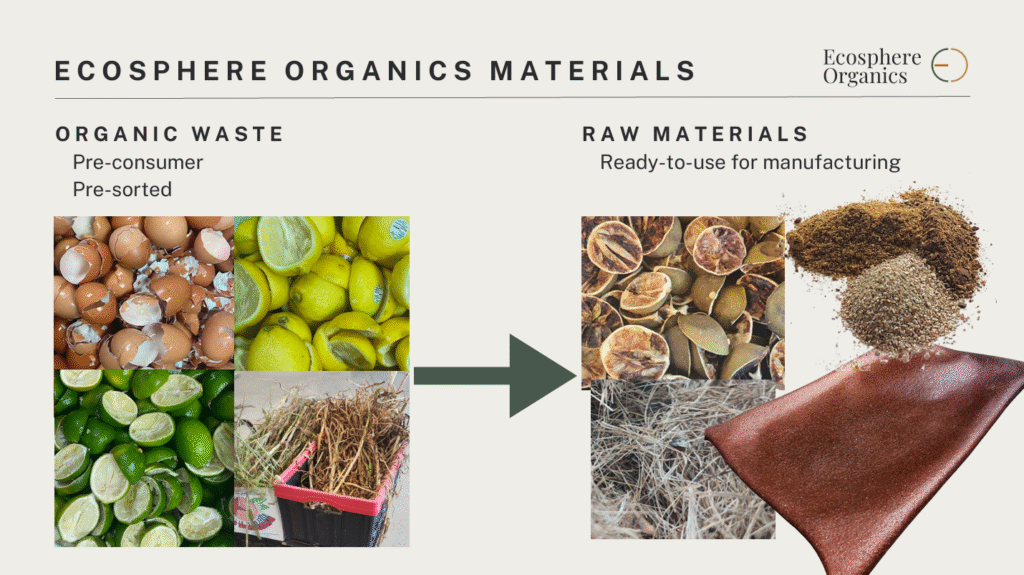
Organic waste, from agricultural residues and food scraps to industrial byproducts, represents a largely untapped asset. Traditionally, these materials have been treated as environmental liabilities, contributing to methane emissions and landfill overcrowding. Yet viewed through a circular economy lens, they can become valuable feedstocks for manufacturing biodegradable and bio-based materials.
This shift in perspective reframes waste not as the end of a linear production process, but as the beginning of a regenerative one. By converting discarded organic matter into inputs for new products, industries can close resource loops, reduce emissions, and foster a circular economy.
Michigan’s Strategic Advantage
Michigan is uniquely positioned to lead this transformation. The state’s vast agricultural sector (second most diverse in the United States) produces significant quantities of organic residues that can be converted into biopolymers, bio-composites, and other sustainable materials. Its long-standing manufacturing base, especially in automotive and materials engineering, provides infrastructure and technical expertise ideal for scaling bio-based production.
Moreover, Michigan’s network of research universities and technical institutes offers a strong foundation for innovation. These institutions can drive advances in material science, process optimization, and commercialization strategies, ensuring that new biomaterials are not only sustainable but also economically viable. Together, these assets form the core of a regional innovation ecosystem dedicated to sustainable production.
Collaboration and Systems Integration
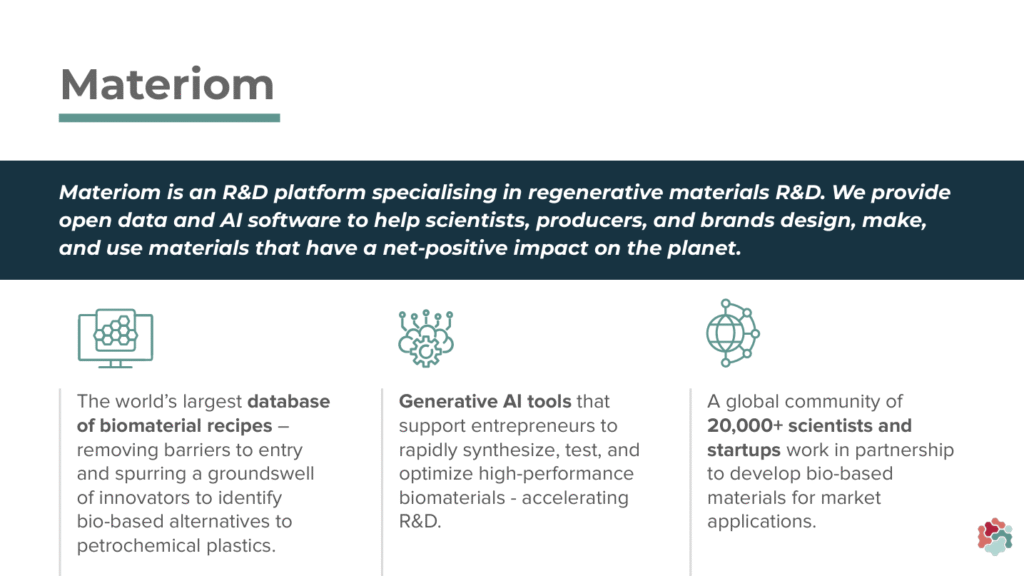
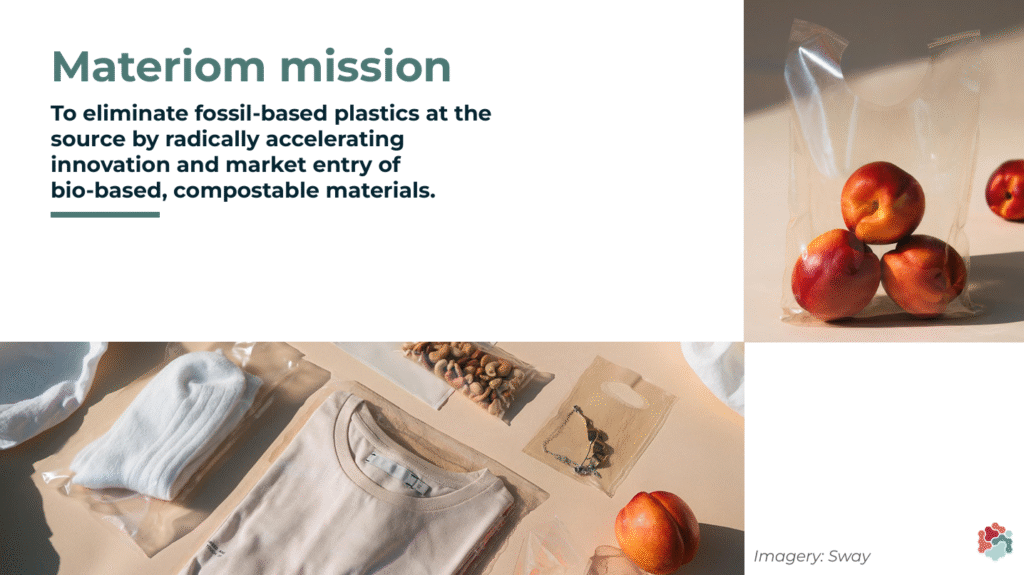
Garmulewicz, CEO and co-founder of international nonprofit Materiom, spoke about using artificial intelligence to accelerate the process of finding new “recipes” for biomaterials. Materiom’s portfolio includes projects based around the world that build out the local value stream and find ways to connect industries with a high volume of biowaste to product developers that can use the open source recipes to create innovative, new, and compostable products.
This includes projects such as Bioplastico Territorial, a data driven platform for seaweed-based bioplastics. Based in Chile, Materiom worked with both local and international project partners to explore the development of an open-source platform that gathers and disseminates scientific data for biomaterials development and the commercial potential for a national bioplastics market in Chile.
Ecosphere Organics founder Brittanie Dabney is a Detroit-based innovator that specializes in transforming organic byproducts into high-value raw materials for a diverse range of industries. Founded in 2024, Ecosphere Organics has maintained the founding goal to drastically reduce greenhouse gas emissions by transforming organic waste into valuable raw materials. It optimizes resource recovery and processing and work with other innovative designers to create novel products that are 100 percent biobased and compostable in industrial facilities. Learn more about her work and the Citrus Coaster here.
Technological breakthroughs alone will not build a biomaterials industry. Success depends on coordinated collaboration among multiple sectors, government agencies, research institutions, private companies, and community organizations. Policies that incentivize waste valorization, investments in pilot facilities, and cross-sector partnerships are essential to overcoming barriers such as feedstock variability, cost of scaling, and market adoption of biomaterials. By integrating environmental, economic, and social objectives, Michigan can establish a model for circular innovation that aligns public and private interests.
Environmental and Economic Impact
Developing a biomaterials industry rooted in organic waste offers both environmental and economic benefits. Environmentally, it reduces methane emissions, lowers landfill usage, and supports the transition to carbon-neutral manufacturing cycles. Economically, it diversifies Michigan’s industrial portfolio, creates jobs in rural and urban communities, and attracts investment from companies seeking sustainable supply chains.
By embedding circularity into material production, Michigan could strengthen its competitive edge in the global green economy. The state’s ability to link waste management, material innovation, and advanced manufacturing could become a model for sustainable regional development.
Toward a Circular Future
Michigan’s pathway to a circular biomaterials economy demonstrates how sustainability and innovation can reinforce one another. By reimagining organic waste as a strategic resource, aligning technological development with policy support, and fostering collaboration across the value chain, the state can transform environmental challenges into engines of economic growth.
As the circular economy continues to evolve, Michigan has the potential to lead by example, showing that a future built on renewable materials and closed-loop systems is not just environmentally necessary but economically smart.
Learn more about the initiative here.