

Webinar: Lessons in Reuse and Circular Design
October 23, 2025
Is your circular economy project gaining the traction it needs? The biggest obstacle facing many sustainability innovators isn’t technical. It’s human. The circular economy thrives on feedback loops: products and materials must return to the system at their highest value. But to close the loop, the end needs to inform the beginning. What does the end know that the beginning should?
In this webinar, the Forum unpacks real-world strategies for aligning sustainability goals with business priorities, navigating internal resistance, and demonstrating the tangible value of circularity in the built environment. Featuring, Heidi Frasure, Head of Sustainability for Green Standards, and Katie Chapman, Lead Sustainability Specialist at Haworth.
For more detail, watch the event recording here on YouTube or embedded below.
Tackling Office Waste Through Sustainable Decommissioning
Each year, approximately 10 million tons of office waste are sent to landfills across the U.S. and Canada. This volume not only contributes to material waste but also to the carbon footprint of the built environment.
Green Standards approaches this challenge by promoting sustainable decommissioning, a process aimed at keeping furniture and assets in their highest possible use through reuse, resale, and donation. The company collaborates with more than 25,000 nonprofit organizations to repurpose furniture that would otherwise be discarded, achieving high landfill diversion rates and delivering tangible social impact.
Circular Design and Use Extension at Haworth
Sustainability is deeply embedded in the DNA of Haworth, a family-owned office furniture company operating in over 150 countries. As explained by Chapman, Haworth’s Circular Economy 2025 Commitments are built around three core pillars:
- Circular Design: 100% of new products use circular design principles
- Circular Services Program: Offer sustainable solutions for customer’s used furniture including repair, refurbish, reuse, recycle, and/or remanfacture.
- Workplace as a Service: Program(s) for Workplace as a Service in place including leasing, pay-per-use.
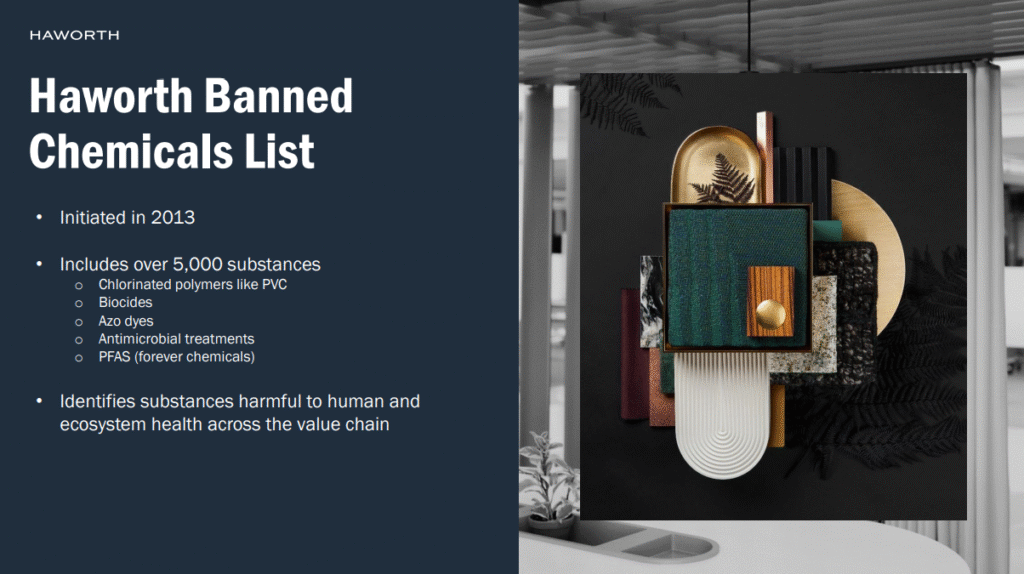
These pillars are seen in practice in Haworth’s recently awarded Fern chair. Production and design of the chair emphasized the use of sustainable and closed-loop materials while avoiding harmful chemicals such as PVC, biocides, PFAS, and others. The company also prioritizes modularity and repairability, ensuring products can be maintained and upgraded rather than replaced. At end-of-life, Haworth products are designed for easy disassembly, supporting more responsible disposal and reuse.
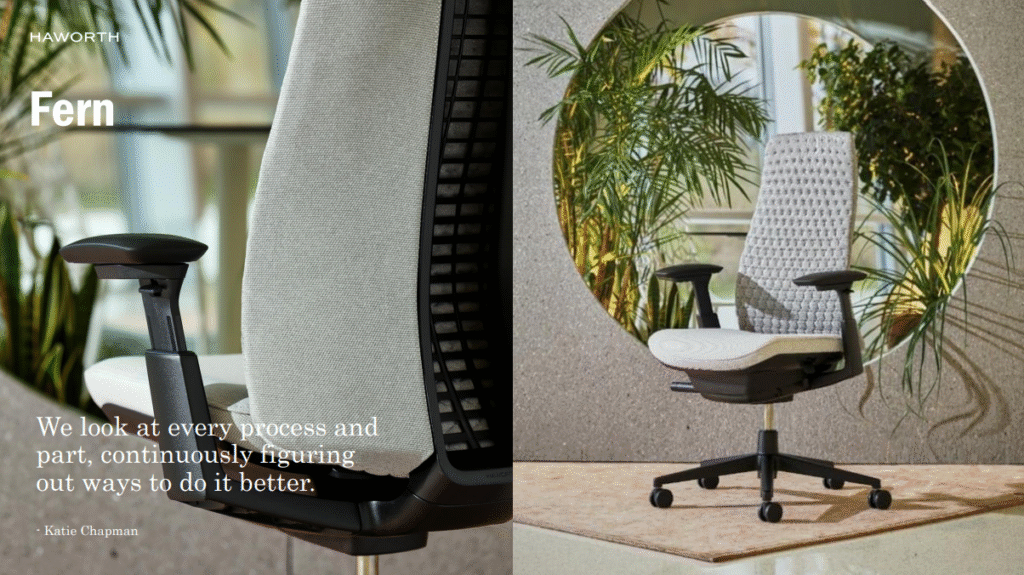
These design decisions not only reduce waste but also result in long-lasting products with high resale value, extending their useful life well beyond the original installation.
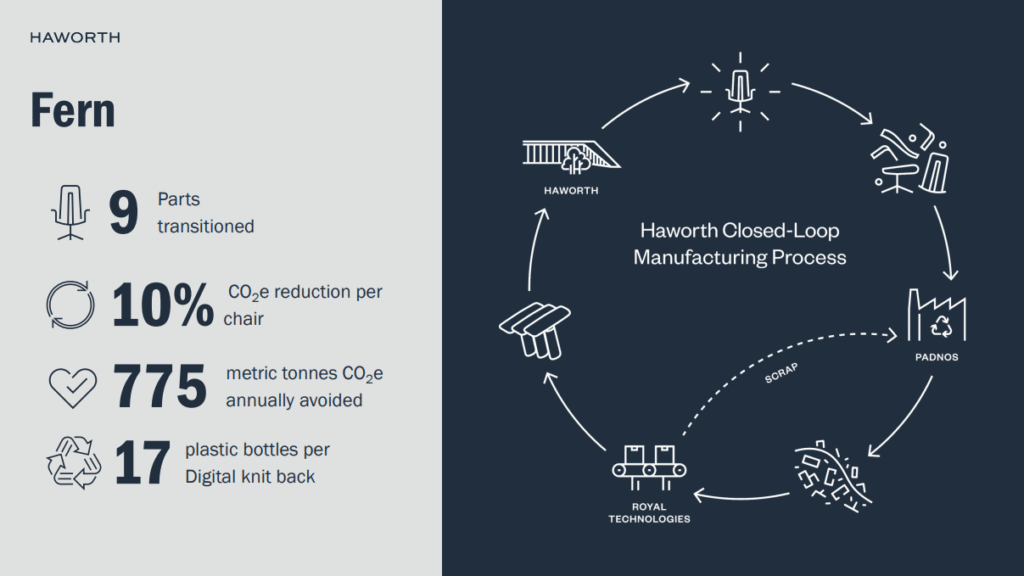
More Than Just Cost Savings: The Broader Benefits of Circularity
Both Frasure and Chapman underscored the non-financial advantages of circular practices. From creating measurable community benefits through donations to reducing corporate risk through better environmental accountability, the circular economy offers multifaceted value to businesses and society alike.
Amid successes in sustainable design and manufacturing, challenges remain with other materials, particularly in the recycling infrastructure for complex materials like wood furniture. The speakers agreed that while recyclability is important, the primary focus should be on durability and longevity. In other words, designing products to last is a more sustainable strategy than simply designing for recyclability.
As businesses become more conscious of their environmental and social impact, the integration of circular economy principles into office furniture design, use, and decommissioning will only grow in importance. Organizations like Green Standards and Haworth are leading by example, demonstrating that sustainability and innovation can go hand in hand, transforming not only how we furnish our workspaces, but how we think about waste and value in the built environment.
>> Check out more upcoming events highlighting sustainability issues and initiatives in Michigan.