How Haworth Corporate Headquarters Deploys Green Stormwater Infrastructure to Protect Local Water Resources
March 13, 2018
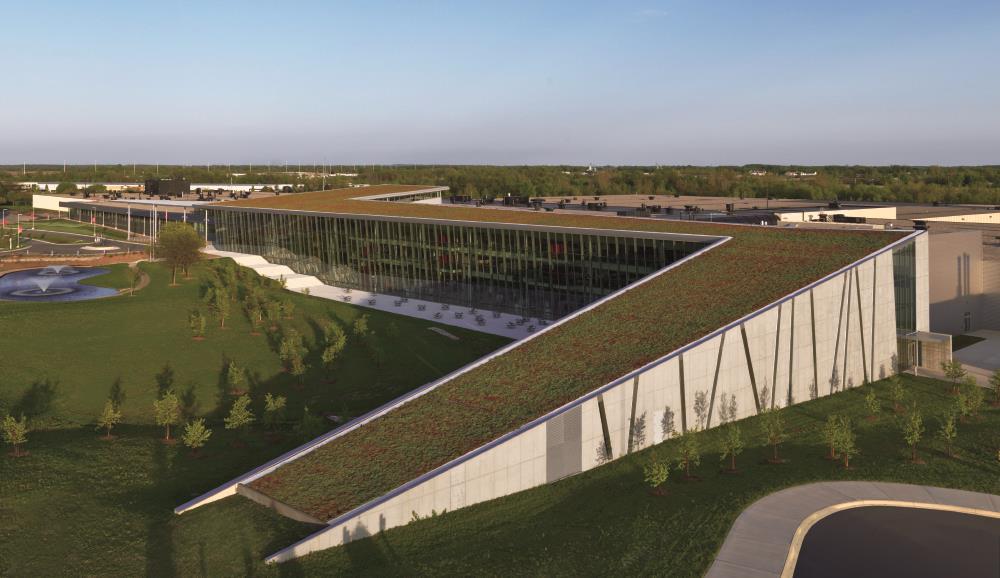
Located in Holland, Michigan, Haworth Inc. operates its corporate headquarters, warehouse, and three manufacturing facilities at its One Haworth Center campus. More than a global leader in workspace solutions, Haworth has long demonstrated how environmental stewardship can be integrated into corporate design, operations, and community engagement.
A major milestone in that commitment came with a 2008 renovation of the Haworth Corporate Headquarters, which expanded the facility to better showcase the company’s products while significantly increasing natural light and incorporating voluntary green stormwater infrastructure (GSI) features. The result is a 300,000-square-foot, LEED-NC Gold certified facility that has become a regional and national example of sustainable site design.
Green Roofs and Stormwater Systems Deliver Environmental Performance
Central to Haworth’s stormwater strategy is a 45,000-square-foot modular green roof, planted with flowering sedum and complemented by white roofing on the warehouse portion of the building. The roof’s west end slopes down three stories, narrowing as it descends and directing stormwater into a bioswale below. To further manage heavy rain events, Haworth installed flow-regulating barriers and enlarged drain holes at the base of the roof edging.In recognition of its design and performance, the roof was named one of the Top 10 Green Roofs Across the Globe by Eva Maddox, then a design principal at Perkins and Will, in a 2010 Huffington Post feature.

The LiveRoof modular system allows water, nutrients, and beneficial organisms to move freely across the rooftop, avoiding the compartmentalized growing medium typical of other modular designs. This supports healthier plant life, reduces heat and moisture extremes, and enhances long-term performance.
Stormwater not captured by the green roof or bioswales flows into four on-site detention ponds, designed for slow infiltration with overflow spillways that are rarely used. A connected stormwater pipe discharges into an on-site creek which flows into the Macatawa River and eventually Lake Macatawa.
Green Stormwater Infrastructure Delivers Cost-Effective Value
Although Haworth did not receive financial incentives for implementing its GSI systems, company leaders believe the long-term benefits outweigh the costs. The modular green roof has proven less expensive to maintain than conventional roofing systems, as individual components can be replaced without disturbing the roof itself. Ongoing maintenance requirements are minimal, consisting primarily of occasional weeding by grounds staff.
The phased implementation of GSI across campus expansions also reduced flooding in impervious areas such as parking lots. Improved stormwater capture in retention, and later detention, basins helped build internal support for further investments in green roofs, bioswales, and rain gardens.
GSI as an Engagement and Restoration Tool
Haworth highlights its environmental initiatives annually in its Sustainability Report, emphasizing efforts to increase green space, improve water quality, and engage employees. Reduced irrigation and less frequent mowing have allowed large portions of the campus to return to natural habitat. The company also maintains a Member Garden, enabling employees to grow food for personal use and community donation.
Employee engagement extends beyond the campus through volunteer efforts to remove invasive species such as garlic mustard and through broader community partnerships.
Haworth is a leader in the Macatawa River Greenway Project, which protects floodplain forests, wetlands, meadows, and riverbanks along the Macatawa River. Early participation in the initiative has helped preserve a natural corridor that improves water quality not only in Lake Macatawa, but ultimately in Lake Michigan.
In support of Project Clarity, a $12 million regional effort to reduce sediment, nutrient, and bacterial pollution in Lake Macatawa, Haworth donated 70 acres of land southeast of its headquarters. This property was the first Project Clarity site restored to its natural wetland condition and may generate future revenue as a wetland mitigation bank. The restored land also provides hiking trails and preserved green space for employees.
Additional Haworth-owned land is leased to a local farmer using low-disturbance, sustainable agricultural practices that reduce runoff and protect soil health.
Through these efforts, Haworth has shown that enabling natural systems to function as designed can achieve meaningful sustainability outcomes, often without reliance on traditional gray infrastructure.
“I’m a big fan of getting the whole system into the room to analyze problems, and I’m also a big fan of looking at problems from a systems standpoint,” says Dick Haworth, Chairman Emeritus, at a Project Clarity groundbreaking ceremony. “That’s what Project Clarity is doing in finding solutions for all parties involved.”
About Haworth
Haworth Inc. is a global leader in workspace solutions, offering furniture and interior products designed to help people do their best work while optimizing real estate. The company engages employees in sustainable practices, reduces its ecological footprint through responsible sourcing and chemical management, and minimizes impacts to local waterways. Haworth’s sustainability efforts support environmental restoration, economic value creation, and stronger communities worldwide.
Sustainable Business of the Year Award
Awarded by the West Michigan Sustainable Business Forum, this honor recognizes Haworth’s leadership in advancing circular economy practices through zero-waste manufacturing, circular product design, and innovative material recovery solutions.
About Green Stormwater Infrastructure
Green Stormwater Infrastructure (GSI) uses natural systems such as green roofs, bioswales, rain gardens, and wetlands to manage stormwater while delivering environmental, economic, and community benefits. MiSBF supports GSI as a scalable, cost-effective strategy for improving water quality, reducing flooding, and restoring ecosystems.