Cómo Hope College implementó a gran escala el uso de envases reutilizables para llevar en un entorno de campus de artes liberales.
May 14, 2026

Hope College is a private liberal arts college in Holland, Michigan with a close-knit residential campus and approximately 2,000 students on meal plans. Dining services operate a dining hall and a retail location on campus and are managed in partnership with Creative Dining Services, a hospitality management company serving institutional and corporate dining centers, markets and event spaces across the Midwest.
Compared to large research universities, Hope’s dining program functions at a smaller scale, with tighter physical footprints, fewer service locations, and operational models designed for efficiency within a smaller footprint.
These constraints shape daily dining operations. While the majority of meals are eaten on site, to-go demand is significant, particularly during lunch hours when seating capacity is limited. Approximately 10 percent of meals are taken to-go, creating a steady stream of packaging needs despite Hope’s emphasis on communal dining.
The Problem: Reducing Waste in a Compact Campus Environment
Hope College’s sustainability challenge within their dining services was not simply reducing waste, but doing so within the limits of a compact campus environment. Space for storage, drying, and container staging is finite, and staffing models rely heavily on efficiency and predictability.
Disposable and compostable packaging offered short-term convenience but introduced long-term concerns: recurring purchasing costs, dependence on vendor supply chains, and the reality that compostable products still require downstream systems and correct sorting to deliver environmental benefits. Dining and sustainability leadership recognized that, without intentional design, compostables risked becoming a different form of single-use waste.
At the same time, student expectations around sustainability were increasing. Dining leadership sought a solution that would be visible, intuitive, and aligned with Hope College’s values of stewardship and shared responsibility.
The Approach: Green To-Go as Built-In Infrastructure
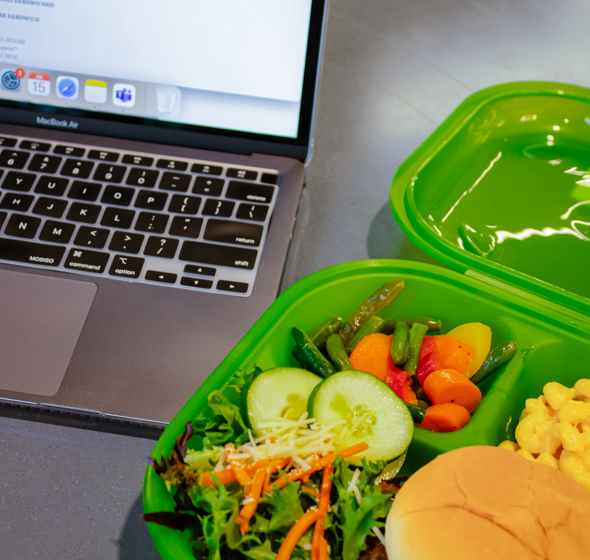
Rather than layering sustainability onto existing systems, Hope College dining services embedded reuse directly into its meal plan structure through the Green2Go Program. Every meal plan student is issued a reusable jade green GET container at the start of the semester, making reuse the default option for takeout meals rather than an elective choice.
The program operates as a closed-loop system tied to student ID accounts. Students check out a container for to-go meals, rinse it after use, and return it to regain credit for their next meal. Faculty and staff may participate through a one-time buy-in, extending the system beyond the student population.
Reusable containers are cleaned using existing industrial dishwashing equipment and air-dried on racks designed to support high-turnover. The Green To-Go system is supported through Creative Dining Services’ vendor partnerships, including GET, which supplies the reusable containers. Container circulation is tied to student ID accounts, allowing dining staff to track check-outs and returns without adding new technology layers. Compostable items (such as Earth Choice soup and smoothie cups) are used selectively when reusable containers are not practical, particularly in retail settings with even smaller kitchen footprints.
Why This Model Fits Hope College
Hope College’s dining leadership chose this approach because it aligned well with the institution’s scale and culture. All students on a meal plan automatically begin with a to-go container associated with their ID card, eliminating the need for deposits, incentives, or complex customer-facing systems. In most cases, students simply return a used container and receive a new one, allowing the reuse cycle to continue seamlessly as part of normal dining operations. When students choose to return a container and have it removed from active circulation on their account, a brief manual process is handled by dining staff. The durability and functionality of the reusable containers also enhanced the student experience, particularly for transporting hot or liquid foods.
Reuse aligned with several priorities simultaneously:
- Reducing waste at the source rather than relying on disposal systems
- Stabilizing costs by minimizing disposable purchasing
- Reinforcing campus norms around shared responsibility
- Ensuring operational consistency across dining locations
Compostables remain part of the college’s sustainability toolkit, but only where reuse is impractical or would create operational friction.
Implementation Experience
Rolling out Green To-Go required upfront costs and coordination as well as ongoing attention to logistics. Drying and storage space emerged as critical factors, requiring intentional back-of-house layout decisions. Container loss does occur, particularly at the beginning of semesters, but remains manageable when expectations are clearly communicated.
Student education is integrated into orientation and reinforced through signage and staff reminders. Frontline dining staff play an essential role in maintaining the system, answering questions, and ensuring containers circulate efficiently. Over time, reuse has become normalized, reducing the need for constant intervention.
Short-term disruptions (like dishwasher outages) occasionally necessitate temporary use of disposable products, highlighting the importance of reliable dishwashing infrastructure. Under normal conditions, however, the system functions smoothly and consistently.
Current Practices
Hope College dining services now operate with a clear hierarchy of foodware use. Reusable plates, utensils, and Green To-Go containers are standard in dining halls. Each year new faculty, staff, and students (freshmen and transfer students) receive a reusable utensil kit as a gift from the college’s Sustainability Committee. Retail locations rely on a limited set of compostable items where necessary, while recycling is available for beverage containers and select packaging. Composting is limited to food waste and coordinated through dining operations.
This approach reflects a design philosophy centered on prevention first, supported by composting and recycling where appropriate.
Outcomes and Broader Relevance
The Green To-Go Program has allowed Hope College to significantly reduce its dependence on single-use foodware while maintaining efficient dining operations within a constrained physical environment. By embedding reuse into everyday dining behavior, the program supports both sustainability goals and operational reliability.
Hope College’s experience demonstrates that reusable container systems are not limited to large universities with extensive infrastructure. With thoughtful design and clear expectations, smaller institutions can advance pollution prevention goals while working within real-world space, staffing, and budget constraints.
Project activities are funded by the U.S. Environmental Protection Agency (EPA) FY23-24 Pollution Prevention Grants: Environmental Justice Through Safer and More Sustainable Products, through the University of Illinois Chicago Institute for Environmental Science and Policy (IESP). Grant recipient work products may not have been formally reviewed by the EPA and may not reflect the views and policies of the EPA. The EPA does not endorse trade names or recommend the use of commercial products mentioned in these documents.
Acerca de Soluciones de Economía Circular
Las prácticas de economía circular industrial se centran en mantener los materiales en uso, desarrollar mercados finales locales y reducir la dependencia de los vertederos. MiSBF promueve estas prácticas porque reducen el impacto ambiental, fortalecen las cadenas de suministro regionales y ayudan a las empresas a alcanzar sus objetivos de sostenibilidad sin perder competitividad.
Obtenga más información sobre las soluciones de economía circular aquí